
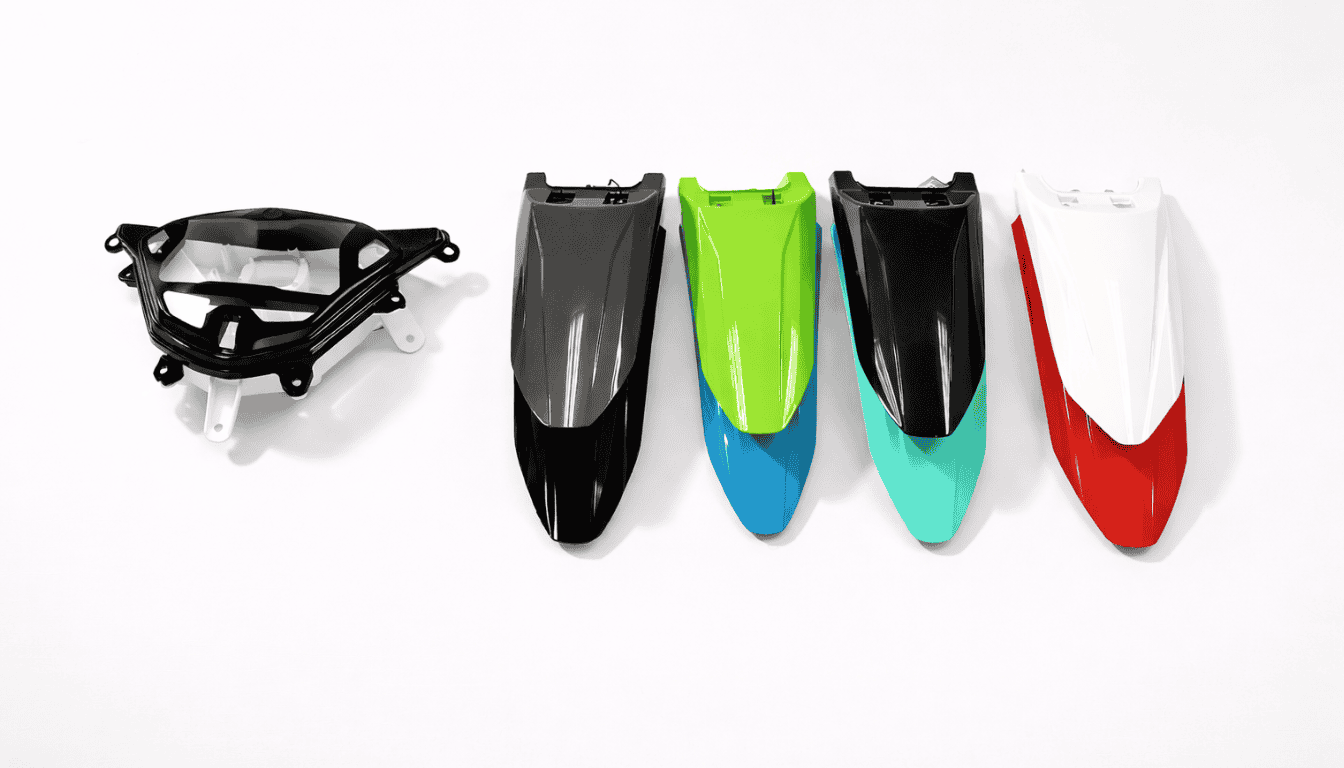
Motorcycle plastic injection molding is a precision thermoplastic manufacturing process used to produce motorcycle components in medium to high production volumes with consistent dimensional control.
The process involves melting polymer resin, injecting it under high pressure into a hardened steel mold cavity, cooling it under controlled conditions, and ejecting the finished part. This method ensures repeatability, tight tolerances, and stable cycle performance—critical for OEM motorcycle programs.
In modern motorcycle manufacturing, injection molding is the primary production method for exterior panels, instrument housings, lighting components, air ducts, and selected engine-adjacent parts. Its scalability and process stability make it the preferred solution for both OEM and Tier-level supply chains.
When properly engineered, injection molding supports lightweight design, assembly precision, and predictable mass production economics.
How Motorcycle Plastic Injection Molding Works
The injection molding cycle consists of several tightly controlled stages, each directly influencing part quality, dimensional stability, and production consistency:
1. Material Feeding
Thermoplastic pellets are fed into a temperature-controlled barrel through a hopper system. For hygroscopic materials such as Polyamide or Polycarbonate, pre-drying is required to prevent hydrolysis and mechanical degradation.
2. Plasticizing
A rotating screw conveys, compresses, and melts the resin while homogenizing temperature and viscosity. Screw design and back pressure settings are critical for consistent melt quality.
3. Injection
The molten polymer is injected under high pressure into a closed, precision-machined steel mold cavity. Injection speed and pressure profiles must be optimized to ensure complete filling without flash or short shot.
4. Packing & Holding
Additional pressure is applied to compensate for volumetric shrinkage as the material begins to cool. This stage directly affects dimensional accuracy, sink mark control, and structural density.
5. Cooling
The part solidifies within temperature-controlled mold channels. Cooling efficiency determines cycle time, warpage behavior, and overall production stability.
6. Ejection
After sufficient solidification, ejector systems release the molded component without inducing deformation or surface damage.
For motorcycle components, maintaining tight tolerances is critical because plastic parts must integrate precisely with metal frames, fasteners, rubber mounts, and electronic assemblies.
Any deviation in shrinkage control, cooling uniformity, or packing pressure can lead to misalignment, vibration noise, or assembly inefficiency.
In high-volume motorcycle programs, stable process control across all stages ensures repeatable geometry, consistent mechanical properties, and predictable mass production performance.
What Type of Plastic Is Used in Motorcycles?
Motorcycles utilize both commodity plastics and engineering plastics, depending on mechanical load, thermal exposure, UV resistance, vibration intensity, and lifecycle expectations of each component.
Material selection is application-driven, not generic.
1. Commodity Plastics (Cosmetic & Non-Structural Components)
Common materials include:
1. Acrylonitrile Butadiene Styrene (ABS)
2. Polypropylene (PP)
Typical Applications:
1. Fairings
2. Side covers
3. Fender panels
4. Interior trim components
Why These Materials Are Used:
1. Good impact resistance for exterior panels
2. Lightweight characteristics for vehicle mass reduction
3. Cost efficiency in high-volume production
4. Ease of molding with high surface finish quality
5. Good paint adhesion (particularly ABS)
ABS is widely used for painted motorcycle body panels due to its rigidity, dimensional consistency, and surface aesthetics.
PP, on the other hand, offers lower density and superior chemical resistance, making it suitable for components exposed to fuel vapor or road contaminants.
For non-load-bearing and cosmetic parts, commodity plastics provide sufficient performance at optimized cost.
2. Engineering Plastics (Structural & High-Heat Areas)
Components exposed to sustained mechanical stress, heat cycling, or vibration require higher-performance polymers.
Common engineering materials include:
1. Polycarbonate (PC)
2. Polyamide (PA6 / PA66, often glass-fiber reinforced)
Typical Applications:
1. Headlamp lenses
2. Instrument panel housings
3. Air intake ducts
4. Engine-adjacent covers
5. Structural brackets
Why These Materials Are Used:
1. Higher tensile strength and stiffness
2. Improved heat deflection temperature
3. Superior creep resistance under sustained load
4. Enhanced dimensional stability in vibration environments
Glass-fiber reinforced polyamide is frequently specified for engine-adjacent components due to its mechanical rigidity and thermal endurance.
Reinforcement improves modulus and reduces long-term deformation, which is critical in components attached to metal frames or subjected to fastener torque.
Polycarbonate is commonly selected for lighting applications because of its high impact strength and optical clarity.
Material Selection Is Application-Specific
Motorcycles do not rely on a single plastic type. Instead, resin selection is determined by:
1. Mechanical load profile
2. Operating temperature range
3. UV and weather exposure
4. Chemical contact (fuel, oil, cleaning agents)
5. Dimensional tolerance requirements
6. Expected product lifecycle
For OEM programs, material selection must be validated early in the design phase to ensure alignment with tooling strategy, processing stability, and long-term production economics.
Common Motorcycle Parts Produced by Injection Molding
Injection molding is integrated across multiple motorcycle systems, covering cosmetic, functional, and semi-structural components.
1. Exterior Body Panels
Typically produced using:
a. Acrylonitrile Butadiene Styrene (ABS)
b. Polypropylene (PP)
These components require:
a. UV stabilization for outdoor durability
b. Impact resistance against road debris
c. Paint adhesion compatibility (especially for ABS)
d. Dimensional consistency for alignment with metal frames
Examples include fairings, side covers, and fender panels. Surface finish quality and color stability are critical, particularly for visible exterior parts.
2. Lighting Components
Headlamp lenses and reflector housings are commonly manufactured from Polycarbonate (PC)
Polycarbonate is selected due to:
a. High optical clarity
b. Exceptional impact resistance
c. Good thermal stability under lighting heat exposure
In lighting systems, dimensional precision is essential to maintain beam alignment and assembly fit with sealing gaskets and housing structures.
3. Engine-Adjacent Components
Air filter housings, intake ducts, and protective engine covers frequently utilize Polyamide (often glass-fiber reinforced)
These components must withstand:
a. Elevated temperatures
b. Continuous vibration
c. Fastener clamping force
d. Long-term creep stress
Glass-fiber reinforcement improves stiffness and reduces deformation, making reinforced polyamide suitable for semi-structural applications near the engine compartment.
4. Electrical Enclosures
Battery covers, relay housings, and switch enclosures often require:
a. Flame-retardant Polycarbonate
b. Engineering-grade thermoplastics with thermal and electrical insulation properties
Key requirements include:
a. Electrical safety compliance
b. Dimensional stability for connector alignment
c. Resistance to heat generated by electronic components
In these applications, material selection is driven not only by mechanical performance but also by safety and regulatory considerations.
Injection molding enables consistent geometry, integrated fastening features, and scalable production across all these motorcycle systems, making it a foundational manufacturing process in modern two-wheeler production.
Material Selection Criteria in Motorcycle Injection Molding
Selecting the appropriate polymer for motorcycle components requires a structured engineering evaluation. Material choice directly affects mechanical integrity, processing stability, and long-term production reliability.
Key evaluation criteria include:
1. Heat Exposure
Components located near the engine, exhaust pathways, or lighting systems must withstand elevated operating temperatures. Materials with higher Heat Deflection Temperature (HDT), such as reinforced Polyamide or Polybutylene Terephthalate, are typically required to prevent deformation under load.
2. Mechanical Load
Structural brackets, mounting interfaces, and fastener retention areas require polymers with higher tensile strength and modulus. Engineering thermoplastics provide improved stiffness, creep resistance, and fatigue durability compared to commodity materials.
3. UV & Weather Resistance
Exterior components such as fairings and fenders must resist ultraviolet degradation, color fading, and surface embrittlement. UV-stabilized grades of Acrylonitrile Butadiene Styrene or Polypropylene are commonly specified for outdoor durability.
4. Chemical Resistance
Exposure to fuel vapor, lubricants, cleaning agents, and road contaminants must be considered. Materials with strong chemical resistance properties, such as polypropylene or selected engineering-grade polymers, reduce long-term cracking and environmental stress failure.
5. Dimensional Stability
Critical mounting interfaces and multi-part assemblies require controlled shrinkage behavior and minimal warpage. Reinforced polymers, particularly glass-filled grades, provide improved dimensional consistency under sustained load and thermal cycling.
Proper material selection ensures mechanical reliability, stable mass production, and reduced long-term failure risk.
In motorcycle injection molding programs, resin choice should be validated early in the design phase to align structural requirements with tooling strategy and lifecycle cost objectives.
Mold Engineering Considerations
Motorcycle plastic injection molding requires optimized mold engineering to ensure dimensional stability, controlled shrinkage behavior, and long-term tooling durability.
Key mold design factors include:
1. Balanced cooling channel layout to ensure uniform heat extraction, minimize warpage, and reduce cycle time variability.
2. Proper gate location and gate type selection to control flow front progression, reduce weld lines, and manage fiber orientation in reinforced materials.
3. Shrinkage compensation within cavity design, accounting for material-specific volumetric contraction and anisotropic behavior (especially in glass-filled polymers).
4. Hardened tool steel or surface treatments when processing abrasive, glass-fiber reinforced materials such as Polyamide to prevent premature cavity wear.
Material rheology, filler content, and thermal properties directly influence:
1. Mold wear rate
2. Dimensional consistency across production cycles
3. Gate erosion and venting performance
4. Long-term production stability
In high-volume motorcycle programs, mold engineering must be aligned with material selection before steel cutting begins to prevent costly modification during mass production.
Injection Molding vs Other Processes
Although compression molding is used for selected thermoset or composite motorcycle parts, injection molding remains the preferred process for thermoplastic components due to:
1. Higher dimensional precision and tolerance control
2. Faster and more predictable production cycles
3. Superior repeatability across large production volumes
4. Improved surface finish quality for visible components
For medium-to-high volume thermoplastic applications, injection molding offers better scalability and lower per-unit cost over the product lifecycle.
Motorcycle plastic injection molding is a high-precision manufacturing solution enabling lightweight, durable, and cost-efficient component production.
Different plastic types ranging from Acrylonitrile Butadiene Styrene and Polypropylene to engineering-grade Polyamide and Polycarbonate are selected based on thermal exposure, mechanical load, chemical resistance, and environmental conditions.
By integrating proper material selection, engineered mold design, and tightly controlled processing parameters, manufacturers can achieve consistent dimensional accuracy, structural reliability, and long-term durability across both OEM and aftermarket motorcycle applications.
Technical Consultation & RFQ Support for Motorcycle Programs
For motorcycle programs requiring high-precision injection molding, controlled dimensional stability, and scalable production capacity, early technical alignment is essential to prevent tooling revisions, cosmetic defects, and long-term production instability.
Banshu Plastic Indonesia supports motorcycle OEMs and component suppliers through a structured, engineering-driven approach, including:
1. Design for Manufacturability (DFM) review for motorcycle components
2. Mold design optimization based on selected resin and functional requirements
3. Tolerance stack-up evaluation for frame and assembly interfaces
4. Production feasibility and scalability analysis
Our engineering team collaborates directly with customers to review:
1. 2D and 3D part drawings
2. Critical dimensional tolerances and fitment requirements
3. Resin specifications (ABS, PP, PC, PA, glass-filled grades, etc.)
4. Projected annual production volumes
5. Target cost and lifecycle expectations
This early-stage technical validation ensures that tooling strategy, material selection, cooling design, and process parameters are aligned before capital investment is committed.
Whether you are developing a new motorcycle platform or optimizing an existing plastic component for weight reduction, durability improvement, or cost efficiency, we provide structured technical evaluation to determine the most suitable molding strategy based on:
1. Mechanical load requirements
2. Thermal exposure near engine or lighting systems
3. UV and environmental resistance
4. Long-term total cost of ownership
Submit your 2D/3D drawings for a technical feasibility review or request a consultation to support your RFQ process. Our team will provide a systematic engineering assessment to strengthen your sourcing decision and ensure stable mass production performance.