
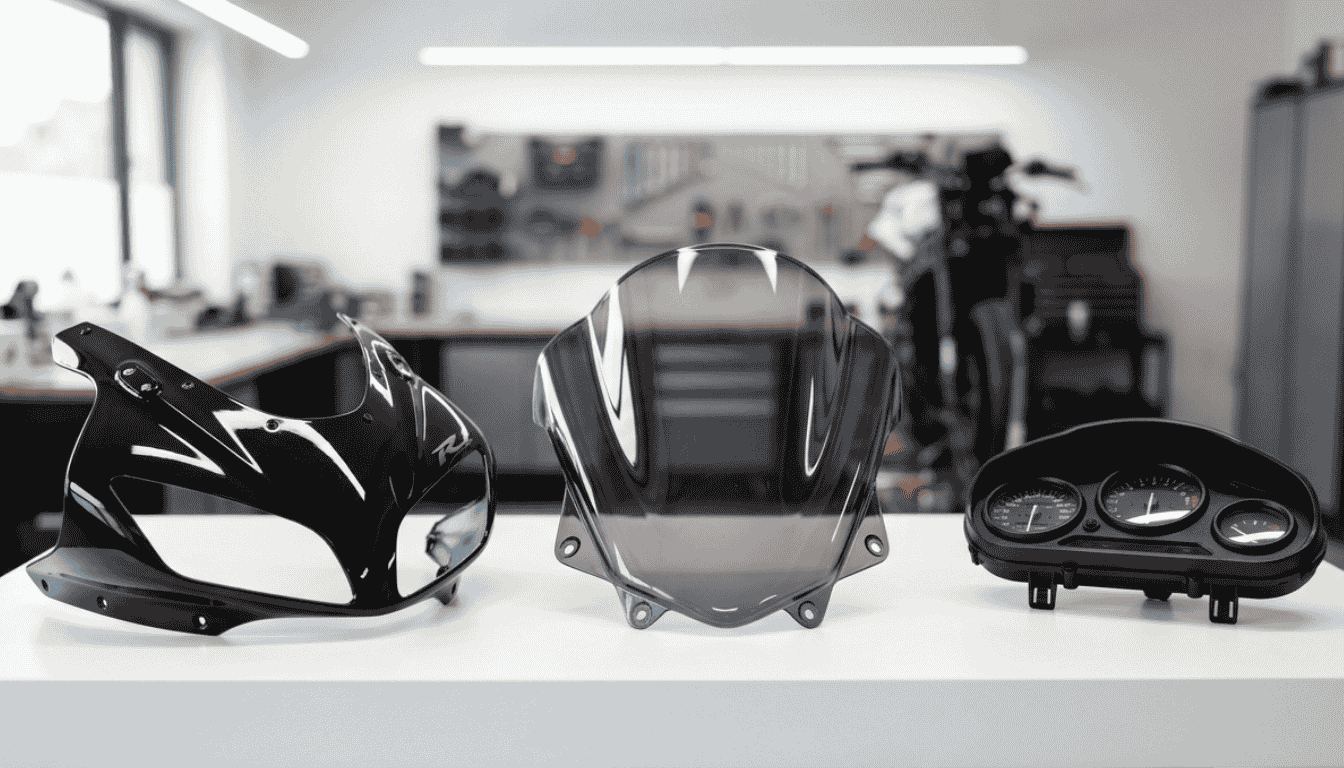
The modern motorcycle industry relies heavily on precision-engineered plastic components that must withstand extreme conditions while maintaining aesthetic appeal and structural integrity.
From aerodynamic fairings to protective body panels, these parts demand careful consideration of material properties, design principles, and manufacturing processes.
Drawing from decades of experience in automotive and motorcycle component manufacturing, this guide provides engineers and product designers with critical insights into optimizing plastic parts for injection molding success.
Understanding Motorcycle Plastic Component Requirements
Motorcycle plastic parts face unique challenges compared to other automotive applications. These components must endure constant exposure to UV radiation, significant temperature fluctuations, and impact forces during normal operation or potential accidents.
Additionally, they encounter chemical exposure from fuel, oil, cleaning agents, and road contaminants.
Performance demands extend beyond durability. Modern motorcycle designs require parts that maintain dimensional stability across temperature variations while achieving precise fitment tolerances.
Surface finish quality varies by application, with some parts requiring high-gloss finishes for aesthetic appeal while others need textured surfaces for grip or visual differentiation.
Color consistency and UV stability are particularly critical for visible components, as fading or discoloration can significantly impact product perception and warranty claims.
Integration considerations also play a vital role. Parts must accommodate mounting systems, fasteners, and interfacing components while maintaining structural integrity.
The balance between aesthetic requirements, functional performance, and manufacturing efficiency drives material selection and design optimization decisions.
Design Principles for Injection Molding
Proper wall thickness optimization forms the foundation of successful injection molded part design.
The critical principle is maintaining uniform thickness throughout the part, minimizing variations that could cause differential cooling rates, internal stresses, warpage, and visible sink marks on exterior surfaces. Consistent wall thickness ensures predictable material flow, uniform cooling, and dimensional stability.
When additional strength is needed, proper ribbing strategies provide reinforcement without adding bulk to nominal wall sections.
Ribs should be designed proportionally to the nominal wall thickness to prevent sink marks opposite the rib while maintaining structural benefits. Proper rib spacing and height ratios help distribute loads effectively without compromising surface quality.
Draft angles are essential for successful mold release and part quality. Minimum draft requirements vary by surface finish, with textured surfaces requiring less draft than high-gloss finishes.
Insufficient draft causes ejection problems, surface scratches, and potentially damaged molds. For deep-draw parts, progressive draft angles may be necessary, increasing as depth increases to facilitate smooth ejection.
Generous radii and fillets improve both part strength and material flow. Sharp corners create stress concentrations that can lead to premature failure and also impede material flow during molding, potentially causing incomplete filling or weld line defects.
Internal and external radii should be proportional to wall thickness, ensuring smooth transitions that promote uniform material distribution.
Gating strategy significantly impacts part quality and appearance. Gate placement requires careful consideration to ensure balanced filling, minimize weld lines in visible areas, and facilitate proper venting.
Edge gates work well for flat panels, submarine gates hide gate vestiges on non-visible surfaces, and hot runner systems eliminate runners entirely for high-volume production. Flow simulation software helps optimize gate locations before committing to tooling.
Boss design for threaded inserts and fasteners requires particular attention. Bosses should be properly supported with ribs or gussets to prevent stress concentration.
Wall thickness around bosses must be sufficient to accommodate inserts without cracking during installation or use, while avoiding excessive thickness that could cause sink marks.
Undercuts present special challenges in mold design. While side actions and lifters can accommodate complex geometries, they add significant tooling cost and cycle time.
Designers should explore alternatives such as snap-fit features, assembly methods, or geometric modifications that eliminate undercuts when possible without compromising functionality.
Tooling Considerations
Mold investment represents a significant portion of total project costs, making informed tooling decisions critical for project success. Mold steel selection depends on expected production volumes and part complexity.
Higher-grade tool steels with proper heat treatment extend mold life for high-volume applications, while more economical steel grades serve moderate production requirements effectively.
The choice between multi-cavity and family molds involves balancing initial investment against per-part costs and production flexibility. Single cavity molds offer lower initial investment but higher per-part costs.
Multi-cavity molds dramatically reduce per-part costs for high-volume production but require larger presses and more complex mold maintenance. Family molds, incorporating multiple different parts in one tool, offer efficient solutions for producing complete assembly sets in single molding cycles.
Hot runner systems versus cold runner configurations present another strategic decision. Hot runner systems eliminate runner waste and reduce cycle times by maintaining material temperature throughout the distribution system.
While initial tooling investment increases, material savings and faster cycles often justify the investment for medium to high production volumes.
Cooling system design directly impacts cycle time and part quality. Properly designed cooling channels ensure uniform temperature distribution throughout the mold, minimizing warpage and reducing cooling time. Advanced cooling technologies such as conformal cooling channels can further optimize thermal management, particularly for complex geometries.
Venting strategy prevents air traps and ensures complete cavity filling. Inadequate venting causes short shots, burn marks, and poor surface finish. Strategic vent placement at parting lines, ejector pins, and flow termination points ensures air can escape as molten plastic fills the cavity.
Manufacturing Process Optimization
Proper process parameter optimization ensures consistent part quality and maximizes production efficiency. Temperature profiles must be carefully controlled across barrel zones, nozzle, and mold surfaces to maintain material integrity while ensuring proper flow characteristics.
Injection pressure and speed require balancing to achieve complete cavity filling without causing flash, burning, or excessive shear heating that could degrade material properties.
Packing pressure and hold time determine final part dimensions and density, directly impacting warpage and sink mark formation.
Insufficient packing pressure results in dimensional inconsistency and potential sink marks, while excessive pressure can cause flash, ejection difficulties, and increased residual stress. Hold time must be sufficient to maintain pressure until the gate freezes, preventing backflow while avoiding unnecessary cycle time extension.
Cooling time optimization balances productivity with part quality. Insufficient cooling results in ejection difficulties and potential part deformation, while excessive cooling time unnecessarily extends cycle time without quality improvement. Cooling time depends on material type, wall thickness, mold temperature, and part geometry.
Common defects require systematic troubleshooting approaches. Sink marks typically result from thick sections or insufficient packing pressure, remedied by optimizing wall thickness uniformity or adjusting packing parameters. Warpage stems from uneven cooling or residual stress, addressed through balanced cooling channel design and potential post-mold annealing or conditioning processes.
Weld lines appear where flow fronts meet, minimized through strategic gate relocation, increased melt temperature, or improved venting. The visibility and strength of weld lines depend on material type, process conditions, and part geometry. For cosmetic surfaces, gate location planning should position weld lines in non-visible or low-stress areas.
Short shots indicate insufficient material or pressure, corrected by adjusting process parameters or verifying material flow characteristics and mold venting. Flash occurs when material escapes parting surfaces, caused by excessive injection pressure, worn mold components, or insufficient clamping force.
Process validation through systematic approaches ensures consistent production quality. Design of experiments methodologies help identify optimal parameter windows, while process capability studies verify that manufacturing processes can consistently meet specification requirements.
First article inspection protocols establish baseline quality standards before full production begins.
Quality Control and Testing Standards
Comprehensive quality control ensures motorcycle parts meet performance specifications throughout their service life.
Dimensional inspection using coordinate measuring machines verifies critical dimensions against CAD models, with optical scanning capturing complex freeform surfaces. Tolerance verification confirms that manufacturing processes consistently deliver parts within specified dimensional limits.
Mechanical testing validates material properties and structural performance. Impact testing confirms that parts can withstand shock loads encountered during use.
Tensile and flexural testing verify strength characteristics, ensuring parts maintain structural integrity under operational loads. Testing protocols should reflect actual use conditions to validate real-world performance.
Environmental testing simulates long-term exposure conditions. Accelerated weathering tests confirm color stability and mechanical property retention under UV exposure.
Thermal cycling validates dimensional stability across temperature extremes encountered in various climates and operating conditions. Chemical resistance testing ensures parts withstand exposure to fuels, oils, and cleaning chemicals without degradation or dimensional changes.
Surface quality assessment ensures aesthetic standards are met consistently. Color consistency measurements verify batch-to-batch uniformity, preventing visible variations in assembled products.
Gloss measurements confirm surface finish meets specifications, while visual inspection standards establish acceptable limits for minor cosmetic imperfections.
In-process quality monitoring catches potential issues before they affect production output. Regular dimensional checks during production runs verify process stability.
Visual inspection identifies surface defects or cosmetic issues. Material verification ensures correct resins and additives are used for each production run.
Design for Manufacturing Best Practices
Early collaboration between design teams and manufacturing partners significantly improves both product quality and cost efficiency.
Design for manufacturability reviews identify potential issues before tooling commitment, when design modifications are still practical and economical. Technical discussions during the concept phase help balance aesthetic goals with manufacturing constraints, ensuring final designs are both attractive and producible.
Material selection guidance from experienced manufacturers helps designers choose optimal polymers for specific applications.
Manufacturers can provide insight into material behavior during processing, long-term performance characteristics, and cost-benefit trade-offs between different material options. This expertise helps avoid costly material changes after tooling investment.
Prototype validation strategies help verify design assumptions before committing to production tooling.
Rapid prototyping technologies such as 3D printing allow physical testing of fit, form, and function. Prototype molds or soft tooling enable limited production runs with actual manufacturing processes, revealing potential issues not apparent in prototypes made by alternative methods.
Cost optimization strategies extend beyond simple material selection. Simplifying mold complexity through design modifications can significantly reduce tooling investment while maintaining functionality.
Volume planning ensures tooling investment aligns with production requirements, avoiding over-investment in unnecessary capacity or under-investment that limits production flexibility.
Sustainability considerations increasingly influence material selection and process design. Choosing recyclable materials and designing parts for easy disassembly facilitates end-of-life recycling.
Minimizing scrap through efficient runner systems and optimal process parameters reduces material waste. Establishing protocols for regrind material usage maintains quality while reducing virgin material consumption.
Tolerance specification should balance functional requirements with manufacturing capability. Overly tight tolerances increase manufacturing cost without providing functional benefit, while insufficient tolerance control causes assembly problems or performance issues.
Understanding manufacturing process capabilities helps specify appropriate tolerances that ensure fit and function without unnecessary cost.
Successful motorcycle plastic part design requires balancing aesthetic requirements, performance specifications, and manufacturing efficiency.
Understanding material properties, applying proper design principles, and optimizing manufacturing processes enable engineers to create components that meet demanding performance requirements while maintaining cost effectiveness.
The complexity of modern motorcycle plastic components demands expertise in polymer science, mold engineering, and production optimization.
Parts must withstand harsh environmental conditions while maintaining precise dimensional accuracy and attractive appearance throughout their service life. Achieving these goals requires careful attention to material selection, thoughtful application of design principles, and systematic process optimization.
Manufacturing considerations should inform design decisions from the earliest concept stages. Features that appear simple on CAD screens may present significant molding challenges, while alternative approaches could achieve the same functionality with improved manufacturability.
Understanding these relationships helps designers create parts that are not only functional and attractive but also economical to produce consistently at high quality levels.
Partnering with experienced injection molding manufacturers early in the design process helps identify potential issues before tooling commitment, ultimately reducing development time and costs while ensuring superior final product quality.
This collaborative approach leverages manufacturing expertise to optimize designs for both performance and producibility, resulting in better products delivered more efficiently.
Technical Consultation & RFQ Support for Motorcycle Plastic Parts
For OEMs and component suppliers developing motorcycle plastic components, early collaboration with an experienced manufacturing partner can significantly improve both material selection and product design for injection molding.
Engaging in technical discussions during the early stage helps ensure that factors such as wall thickness design, structural reinforcement, material performance, and moldability are properly evaluated before tooling development begins.
Banshu Plastic Indonesia supports motorcycle plastic injection molding projects through structured Design for Manufacturability (DFM) evaluation, material selection guidance, and optimized mold engineering.
This approach helps ensure that components such as fairings, housings, covers, and other motorcycle plastic parts can be manufactured with stable dimensional accuracy, reliable performance, and consistent production quality.
Manufacturers and product development teams can submit their 2D or 3D part drawings for a technical feasibility review or request RFQ support to evaluate the most appropriate material options, tooling strategy, and mass production capability for their motorcycle components.
Through a systematic engineering assessment, our team helps OEMs and suppliers make more informed sourcing decisions while ensuring efficient, repeatable manufacturing performance in high-volume motorcycle parts production.
For technical consultation or to discuss your motorcycle plastic component requirements, contact our engineering team to initiate a DFM review and explore manufacturing solutions tailored to your specific project needs.