
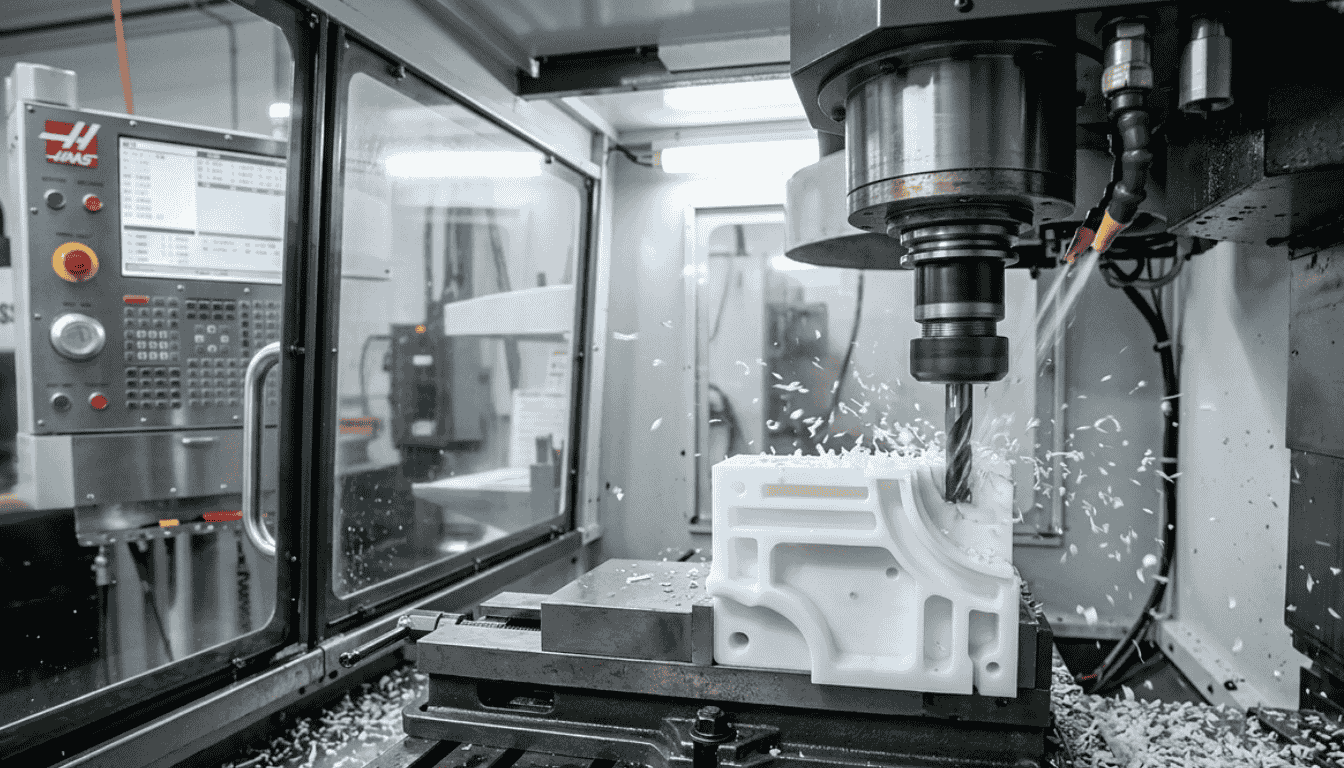
CNC plastic machining is widely used in modern manufacturing for producing high-precision plastic components, particularly in applications where tight tolerances, complex geometries, and low-to-medium production volumes are required.
Unlike injection molding, which relies on dedicated tooling for mass production, CNC machining offers greater flexibility in design iteration and material selection. This makes it a preferred solution for prototyping, functional testing, and specialized industrial applications.
However, machining plastics introduces unique challenges compared to metals, including material deformation, thermal sensitivity, and dimensional instability. Understanding the machining process, material behavior, and tolerance capabilities is essential for achieving consistent and reliable results.
CNC Plastic Machining Process Overview
CNC (Computer Numerical Control) plastic machining is a subtractive manufacturing process in which material is removed from solid thermoplastic stock using precision cutting tools governed by programmed toolpaths. Unlike injection molding, this process does not require tooling, making it highly suitable for prototyping, low-volume production, and applications requiring tight tolerances or complex geometries.
From an engineering perspective, successful plastic machining requires careful consideration of material behavior, tool selection, and thermal management, as thermoplastics are significantly more sensitive to heat and deformation compared to metals.
The typical process includes:
1. CAD Model Preparation
A 2D or 3D CAD model is developed to define part geometry, dimensional tolerances, and critical features. At this stage, designers must account for machining constraints such as tool accessibility, minimum internal radii (based on cutter diameter), and fixturing strategy.
For engineering plastics, tolerance specification should also consider material-specific factors such as thermal expansion and stress relaxation, particularly for high-precision or load-bearing components.
2. CAM Programming
CAM (Computer-Aided Manufacturing) software is used to generate optimized toolpaths that control cutting operations such as milling, drilling, and turning.
Key considerations include cutting strategy, feed rate, spindle speed, and step-over/step-down parameters. Unlike metal machining, aggressive cutting conditions can lead to heat accumulation, resulting in material softening or dimensional inaccuracy in plastics.
Efficient toolpath planning is essential not only for surface quality but also for minimizing internal stress and ensuring repeatability.
3. Material Setup (Fixturing)
Plastic stock material must be securely fixtured to prevent movement, vibration, or deformation during machining. Due to the relatively lower stiffness of plastics compared to metals, improper clamping can lead to part distortion or dimensional deviation.
In some cases, soft jaws, vacuum fixtures, or custom jigs are used to distribute clamping force evenly and avoid localized stress concentration.
4. Machining Operations
CNC machines execute a range of operations depending on part geometry:
-Milling: used for producing complex geometries, flat surfaces, and internal pockets
-Turning: applied for cylindrical or rotationally symmetric components
-Drilling: used for holes, threads, and internal features
From a process standpoint, tool sharpness, chip evacuation, and heat dissipation are critical factors. Poor chip removal can lead to re-cutting, which increases friction and raises the risk of surface defects or melting.
5. Finishing & Inspection
Post-machining processes may include deburring, polishing, annealing (in specific applications), and dimensional inspection to ensure compliance with design specifications.
For high-performance components, stress-relief treatments may be required to minimize internal stress induced during machining, which can otherwise lead to dimensional instability or part deformation over time.
Inspection is particularly critical for tight-tolerance components, as thermoplastics may undergo slight dimensional changes after machining due to stress relaxation, temperature variation, or moisture absorption, depending on the material type.
Compared to metal machining, CNC plastic machining requires tighter control of cutting parameters to prevent issues such as localized melting, edge chipping, burr formation, and internal stress accumulation. These risks are primarily driven by the lower thermal conductivity and higher sensitivity of plastics to heat and mechanical loading during cutting.
Factors such as lower thermal conductivity, higher coefficient of thermal expansion, and viscoelastic behavior make process optimization essential for achieving consistent dimensional accuracy and surface quality.
Common Materials Used in CNC Plastic Machining
Material selection plays a critical role in determining machining performance, dimensional accuracy, and final part quality in CNC plastic machining. Each thermoplastic exhibits distinct mechanical properties, thermal behavior, and machining characteristics, which directly influence tool wear, surface finish, and process stability.
From a machining perspective, factors such as stiffness, heat resistance, chip formation, and moisture sensitivity must be evaluated alongside functional requirements.
ABS (Acrylonitrile Butadiene Styrene)
1. Good impact resistance and toughness
2. Easy to machine with stable cutting performance
3. Produces consistent surface finish with low tool wear
ABS is commonly used for prototyping and general-purpose components due to its balanced properties and good machinability. However, its moderate heat resistance requires controlled cutting parameters to avoid surface softening.
POM (Acetal / Delrin)
1. High dimensional stability and low moisture absorption
2. Low friction coefficient and excellent wear resistance
3. Clean chip formation for precise machining
POM is well-suited for precision components such as gears, bushings, and sliding parts. Its stability during machining makes it ideal for tight-tolerance applications with minimal post-processing.
Nylon (PA)
1. High strength, toughness, and wear resistance
2. Good fatigue resistance under repeated loading
3. Absorbs moisture, which can affect dimensional stability
While Nylon provides strong mechanical performance, its moisture absorption can lead to dimensional variation during and after machining. Environmental control or material conditioning may be required for precision parts.
PTFE (Teflon)
1. Excellent chemical resistance and very low friction
2. Soft material with low stiffness
3. Prone to deformation during machining
PTFE is challenging to machine due to its tendency to deflect under cutting forces. Proper fixturing, sharp tools, and conservative cutting parameters are necessary to maintain dimensional accuracy.
Polycarbonate (PC)
1. High impact resistance and optical clarity
2. Suitable for transparent and impact-resistant components
3. Sensitive to heat during machining
PC requires careful temperature control to prevent melting or surface defects. Optimized cutting speeds and sharp tools are important to maintain surface quality.
PEEK (Polyether Ether Ketone)
1. High-performance engineering plastic
2. Excellent thermal stability and chemical resistance
3. Maintains mechanical properties at elevated temperatures
PEEK is widely used in aerospace, medical, and high-performance applications. Its high strength and heat resistance result in higher cutting forces, requiring rigid setups and optimized machining strategies.
Selecting the appropriate material requires balancing application requirements such as mechanical load, temperature exposure, chemical resistance, and dimensional tolerance with machining considerations including heat generation, tool interaction, and process stability.
A mismatch between material properties and machining conditions can lead to issues such as poor surface finish, dimensional inaccuracy, and excessive tool wear, making early-stage material selection a key factor in achieving consistent production quality.
Tolerance Capabilities in CNC Plastic Machining
One of the key advantages of CNC plastic machining is its capability to achieve tighter dimensional tolerances compared to many conventional molding processes, particularly for low-volume or precision-critical components. This makes CNC machining a preferred method for functional prototypes, mating parts, and components requiring high dimensional accuracy.
Typical tolerance ranges include:
1. General tolerance: ±0.05 mm to ±0.10 mm
2. High-precision components: up to ±0.01 mm (depending on material type, geometry, and machining conditions)
However, maintaining tight tolerances in thermoplastics is inherently more complex than in metals due to their material-specific behavior under thermal and mechanical loads.
Thermal Expansion
Plastics generally have higher coefficients of thermal expansion compared to metals, making them more sensitive to temperature fluctuations during machining and post-processing. Heat generated at the cutting interface can cause temporary expansion, followed by contraction after cooling, resulting in dimensional variation.
Material Deformation (Deflection)
Compared to metals, many plastics have lower modulus of elasticity, making them more prone to elastic deformation under cutting forces. This deflection can lead to dimensional inaccuracy, particularly in thin-walled or unsupported features.
Proper toolpath strategy, reduced cutting forces, and stable fixturing are essential to minimize this effect.
Internal Stress (Residual Stress)
Machining operations can introduce residual stress into the material due to localized heat and mechanical loading. Over time, this stress may be released, causing part distortion or dimensional drift, especially in high-precision applications.
In some cases, stress-relief processes or staged machining strategies are required to maintain long-term stability.
Moisture Absorption
Certain engineering plastics, such as Nylon (PA), are hygroscopic and can absorb moisture from the environment. This can lead to measurable dimensional changes, particularly in tight-tolerance components or precision assemblies.
Controlling storage conditions and performing machining in a stable environment are critical to minimizing this effect.
To achieve and maintain tolerance stability, machining parameters must be optimized in relation to material behavior. This includes selecting appropriate cutting speeds, feed rates, and tool geometry, as well as implementing rigid and well-distributed fixturing methods.
From an engineering standpoint, tolerance control in plastic machining is not solely a function of machine capability, but a combination of material selection, process control, and environmental management.
Key Machining Considerations for Plastics
To achieve consistent and high-quality results in CNC plastic machining, several key engineering considerations must be systematically addressed. Unlike metal machining, plastics require tighter control over thermal and mechanical interactions to prevent dimensional instability and surface defects.
Cutting Parameters Optimization
Cutting parameters must be carefully calibrated based on the material’s thermal sensitivity and mechanical properties.
1. Use appropriate spindle speed and feed rate to maintain efficient material removal without excessive heat buildup
2. Avoid aggressive cutting conditions that can lead to localized melting or surface smearing
3. Ensure stable and continuous cutting to produce clean edges and consistent surface finish
From a process standpoint, maintaining a balance between cutting efficiency and thermal control is critical for repeatable quality.
Tool Selection
Tool geometry and sharpness have a significant impact on machining performance in plastics.
1. Sharp cutting tools reduce friction, minimizing heat generation and improving surface finish
2. Polished flutes and optimized rake angles help facilitate smooth chip evacuation
3. Specialized tooling may be required for high-performance plastics such as PEEK, where higher cutting forces are involved
Worn or inappropriate tools can rapidly degrade part quality, especially in tight-tolerance applications.
Fixturing and Clamping
Proper fixturing is essential to maintain dimensional accuracy, particularly for materials with lower stiffness.
1. Ensure adequate support to prevent vibration and part deflection during machining
2. Distribute clamping forces evenly to avoid localized deformation
3. Avoid over-clamping, especially for softer or thin-walled components, as this can introduce dimensional distortion
Custom fixtures or soft jaws are often required for complex geometries or precision parts.
Cooling Strategy
Effective heat management is a critical factor in plastic machining.
1. Air cooling is commonly preferred over liquid coolant to prevent contamination, swelling, or adverse material interaction
2. Maintain consistent temperature at the cutting zone to reduce thermal expansion effects
3. Optimize chip evacuation to minimize heat accumulation and re-cutting
Unlike metals, excessive cooling or improper coolant selection can negatively affect certain plastic materials.
Post-Machining Stability
Dimensional stability after machining must be considered, particularly for high-precision components.
1. Stress-relief processes (such as controlled annealing) may be required to reduce residual stress and prevent long-term deformation
2. Controlled storage conditions, temperature and humidity are important to maintain dimensional consistency, especially for hygroscopic materials
From an engineering perspective, achieving stable final dimensions extends beyond machining and requires control over post-processing and environmental factors.
Applications of CNC Plastic Machining
CNC plastic machining is widely utilized across industries where precision, material performance, and production flexibility are critical.
Its ability to produce functional parts without tooling investment makes it particularly valuable for both early-stage development and specialized low-volume production.
From an engineering and sourcing perspective, CNC machining is often selected when design iteration speed, tight tolerances, or material-specific performance outweigh the cost advantages of mass production processes.
Prototyping and Product Development
1. Enables rapid design iteration without tooling investment
2. Supports functional testing under real operating conditions
3. Allows validation of geometry, fit, and performance prior to injection molding
CNC machining is especially valuable in bridging the gap between concept design and mass production, reducing development risk and enabling faster time-to-market.
Automotive Components
1. Custom housings and enclosures for specific configurations
2. Electrically insulating components
3 . Low-volume or specialized parts not suitable for molding
In automotive applications, CNC machining is often used for pre-production validation, spare parts, or components with complex geometries and tight tolerances that are not economically feasible for tooling.
Electronics and Electrical Applications
1. Non-conductive enclosures for sensitive components
2. Insulation parts with precise dimensional requirements
3. Connector housings and support structures
Material stability and electrical insulation properties make engineering plastics suitable for high-precision electronic applications, where dimensional accuracy directly affects assembly and performance.
Industrial Equipment
1. Wear-resistant components such as bushings and guides
2. Custom jigs, fixtures, and alignment tools
3. Replacement parts for maintenance and repair
CNC machining provides flexibility for producing durable components in small quantities, particularly for equipment with customized or legacy designs.
Medical and High-Performance Applications
1. Components manufactured from high-performance plastics such as PEEK
2. Applications requiring high chemical resistance and thermal stability
3. Precision parts with strict dimensional and material compliance requirements
In these sectors, material traceability, dimensional consistency, and machining precision are critical, making CNC machining a suitable process for producing high-value, performance-critical components.
CNC Machining vs Injection Molding
While both processes are used to produce plastic parts, their applications differ significantly:
1. CNC Machining
- Ideal for low-volume production
- No tooling required
- High flexibility and fast turnaround
2. Injection Molding
- Suitable for high-volume production
- Requires mold investment
- Lower cost per part at scale
In many cases, CNC machining is used during early development stages before transitioning to injection molding for mass production.
CNC plastic machining provides a highly flexible and precise manufacturing solution for producing complex plastic components, particularly in low-to-medium volume applications.
However, successful machining requires a deep understanding of material behavior, process parameters, and tolerance limitations. Unlike metals, plastics present unique challenges that must be addressed through careful engineering consideration.
By aligning material selection, machining strategy, and design requirements, manufacturers can achieve high-quality, dimensionally stable plastic components suitable for a wide range of industrial applications.
Technical Consultation & RFQ Support for CNC Plastic Machining
For engineering teams and manufacturers developing precision plastic components, early collaboration with a machining partner can significantly improve design feasibility, material selection, and production efficiency.
By engaging in technical discussions during the early development stage, factors such as tolerance requirements, material behavior, machining strategy, and structural design can be properly evaluated before production begins.
Banshu Plastic Indonesia supports CNC plastic machining projects through a structured engineering approach, including material selection guidance, manufacturability analysis, and precision machining capabilities. This ensures that components meet dimensional accuracy requirements while maintaining consistent performance and quality.
Engineering teams and procurement professionals can submit 3D drawings for technical review or request RFQ support to evaluate suitable materials, machining strategies, and production scalability.
For technical consultation or to discuss your CNC plastic machining requirements, contact our engineering team to explore manufacturing solutions tailored to your application and performance needs.