
The global manufacturing landscape is undergoing a significant shift. Increasing supply chain volatility, cost unpredictability, and geopolitical uncertainty are forcing companies to rethink how and where they source their components.
For many OEMs and procurement teams, reliance on a single-region manufacturing strategy is no longer sustainable. Disruptions whether logistical, economic, or regulatory can have a direct impact on production continuity and overall business performance.
As a result, manufacturers are moving away from purely cost-driven sourcing decisions toward a more strategic approach, one that prioritizes resilience, flexibility, and long-term stability.
In this context, Southeast Asia has emerged as a key region in global supply chain diversification. Among its growing manufacturing bases, Indonesia is increasingly recognized as a viable and competitive location for plastic injection molding.
Why Global OEMs Are Rethinking Manufacturing Strategies
Supply Chain Concentration Risks
Over-reliance on a single manufacturing region creates structural vulnerability. When disruptions occur, companies with concentrated supply chains often face delays, cost spikes, and reduced production flexibility.
Cost Instability and Tariff Exposure
Fluctuating landed costs, including tariffs and logistics expenses, make long-term cost planning more challenging. Even traditionally cost-efficient regions may no longer offer predictable pricing over time.
The Shift Toward Supply Chain Diversification
To mitigate these risks, global OEMs are adopting multi-region sourcing strategies. This approach distributes risk across different geographies and improves overall supply chain resilience.
The focus is no longer on finding the lowest-cost supplier, but on building a balanced and reliable manufacturing network.
Indonesia as a Strategic Manufacturing Location in Southeast Asia
Regional Stability and Strategic Position
Indonesia is positioned within the Southeast Asian manufacturing corridor, offering proximity to major global shipping routes while maintaining relative insulation from geopolitical tensions affecting other regions.
Cost Competitiveness with Long-Term Stability
Rather than competing solely on the lowest labor cost, Indonesia offers a more stable cost structure. This allows manufacturers to better manage long-term production planning without significant fluctuations in operational expenses.
Expanding Industrial Manufacturing Ecosystem
Indonesia’s manufacturing sector continues to grow, supported by increasing investment in industrial infrastructure, skilled labor, and integration into global supply chains. This development enhances its capability to support export-oriented
production for international markets.
Banshu Plastic Indonesia Capabilities
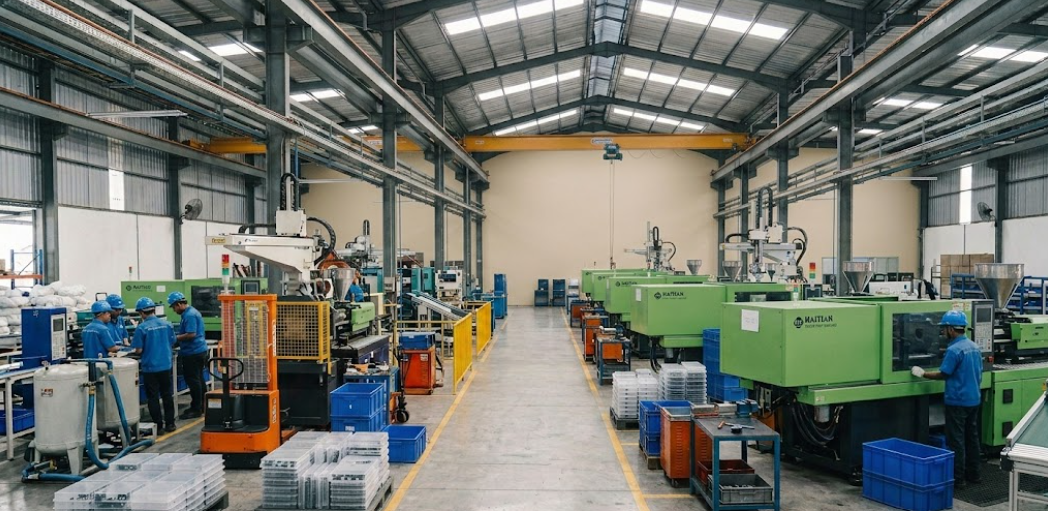
From a technical perspective, plastic injection molding capabilities in Indonesia especially Banshu Plastic have evolved to meet the requirements of global OEM production.
Production Capabilities
Manufacturers are able to support both mid-volume and high-volume production, producing custom plastic components tailored to specific application requirements. Process control and repeatability are critical to ensuring consistent output across production runs.
Material Range
A wide range of materials is available, including:
1. Commodity plastics such as PP, PE, and ABS
2. Engineering plastics such as Nylon (PA), Polycarbonate (PC), and POM
Material selection is typically aligned with functional requirements, including mechanical strength, thermal resistance, and dimensional stability.
Tooling and Mold Capabilities
Tooling plays a critical role in injection molding performance. Capabilities typically include:
1. Single-cavity and multi-cavity molds
2. Hot runner and cold runner systems
3. Mold designs optimized for cycle efficiency and part quality
Manufacturers with in-house mold development capability are better positioned to control tooling quality, lead time, and long-term production performance.
Integrated Manufacturing Capabilities
One of the key advantages for OEMs is working with manufacturers that offer integrated production capabilities. This reduces coordination complexity and improves overall efficiency.
At Banshu Plastic, this integrated approach includes:
1. Plastic Injection Molding for scalable production of custom components
2. Mold Making (Tooling Engineering) to support production-grade molds with controlled quality and lead time
3. Jig and Checking Fixtures to ensure dimensional accuracy and consistent quality during production
4. Metal Stamping as a complementary process for hybrid components or assemblies
By combining these capabilities within a single manufacturing ecosystem, companies can streamline supplier management while improving consistency across the production process.
Quality Standards and Export Readiness
Quality Control Systems
Maintaining consistent quality is essential for global OEM production. This includes:
1. Dimensional inspection
2. Process monitoring
3. Batch-to-batch consistency
Certified Manufacturing System
Banshu Plastic operates under internationally recognized standards, including:
1. ISO 9001:2015 for quality management systems
2. IATF 16949:2016 for automotive manufacturing requirements
3. ISO 14001:2015 for environmental management
These certifications ensure structured process control, traceability, and compliance with global manufacturing expectations particularly for automotive and industrial applications.
Tolerance and Precision Capability
Injection molding processes are capable of maintaining tight tolerances, particularly for functional components that require precise fit and performance. Repeatability across production batches is a key factor in ensuring assembly consistency.
Export Capability and Logistics Support
Beyond manufacturing, export readiness is a critical factor for international clients.
Banshu Plastic has experience supporting overseas shipments, working with reliable export-import partners to manage logistics, documentation, and compliance requirements. This ensures that components can be delivered efficiently and reliably across global markets.
Export capability is not only about shipping products, but also about maintaining consistency in delivery schedules, documentation accuracy, and communication across different regions.
Comparing Manufacturing Strategies: Single-Region vs Diversified Sourcing
Limitations of Single-Region Dependency
Relying on a single manufacturing region can limit flexibility and increase exposure to disruption. This model may offer short-term cost advantages but often lacks resilience in the face of global uncertainty.
Advantages of Diversified Manufacturing
A diversified sourcing strategy provides several benefits:
1. Reduced risk exposure
2. Improved supply chain resilience
3. Greater flexibility in production planning
The Role of Southeast Asia
Southeast Asia is increasingly being integrated into global manufacturing strategies as an alternative production base. Its growing capabilities and strategic positioning make it a practical option for companies seeking to balance cost efficiency with long-term stability.
Applications of Plastic Injection Molding for Global OEMs
Automotive Components
Injection molding is widely used for automotive applications, including interior and exterior parts, housings, and functional components that require durability and precision.
Electronics and Consumer Products
Plastic enclosures, connectors, and precision components are commonly produced using injection molding due to its ability to maintain consistent quality at scale.
Industrial and Mechanical Applications
Custom-engineered plastic parts are used in various industrial systems, including structural components, guides, and mechanical elements.
OEM Custom Manufacturing
Many applications require application-specific solutions, where components are designed and manufactured based on unique product requirements. This often involves close collaboration between design and manufacturing teams.
Key Considerations When Choosing an Injection Molding Partner
Engineering Capability
A strong manufacturing partner should be able to provide Design for Manufacturability (DFM) support and material selection guidance to optimize product performance and production efficiency.
Tooling and Production Capability
In-house mold development and scalable production capabilities are critical for maintaining quality and meeting production timelines.
Quality and Consistency
Structured process control, inspection systems, and certified quality standards ensure that parts meet specifications consistently across production runs.
Communication and Project Management
For global OEMs, responsiveness, technical clarity, and the ability to manage cross-border projects are essential factors in successful collaboration.
Selecting a manufacturing partner is not only about cost, it is about long-term reliability, engineering capability, and the ability to support a stable supply chain.
Global sourcing strategies are evolving. Companies are no longer focused solely on minimizing cost, but on building manufacturing systems that are resilient, flexible, and scalable.
Indonesia is emerging as a strategic manufacturing location that offers a balance between cost efficiency and operational stability. With growing capabilities in injection molding, tooling, and integrated manufacturing processes, it provides a viable alternative for global OEM production.
A diversified sourcing strategy enables manufacturers to reduce risk, improve flexibility, and maintain consistent production performance in an increasingly complex global environment.
Technical Consultation & RFQ Support
For OEMs and procurement teams evaluating alternative manufacturing strategies, early collaboration with a qualified partner can significantly improve sourcing outcomes.
Banshu Plastic supports global customers through an integrated manufacturing approach, combining injection molding, tooling, fixture development, and secondary processes within a controlled production environment.
Engineering teams can submit 3D drawings for technical evaluation, including Design for Manufacturability (DFM) analysis, material selection guidance, and tooling strategy recommendations.
For RFQ requests or to discuss your project requirements, contact our engineering team to explore manufacturing solutions aligned with your supply chain strategy and production goals.