
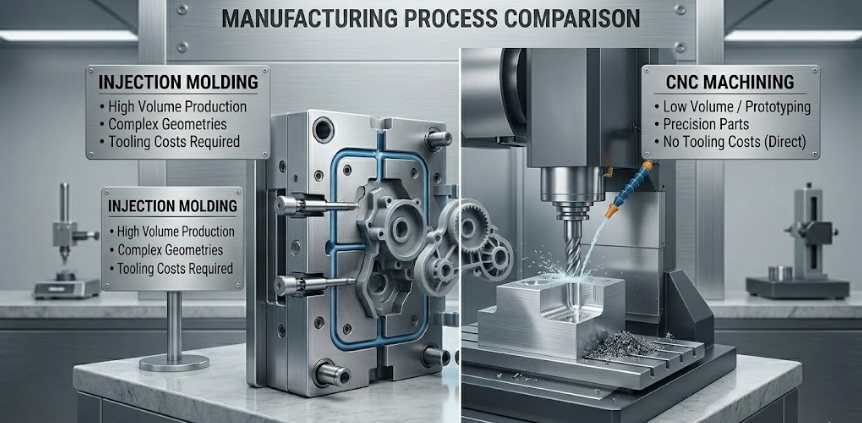
Manufacturers developing plastic or mechanical components often face the same production decision during the sourcing and engineering phase: should the part be produced using injection molding or CNC machining? Both manufacturing methods are widely used across industrial sectors, yet each process serves different production objectives, cost structures, and scalability requirements.
For OEM buyers, product engineers, and procurement teams, selecting the wrong manufacturing method can significantly affect production cost, lead time, tooling investment, and long-term supply chain efficiency.
A process that works well for prototyping may become economically inefficient for mass production, while a method optimized for high-volume manufacturing may create unnecessary upfront investment during early product development.
Understanding the differences between injection molding and CNC machining is therefore essential before launching a manufacturing program.
Understanding Injection Molding
Injection molding is a manufacturing process that produces parts by injecting molten plastic material into a precision mold cavity under controlled pressure and temperature. After cooling and solidification, the molded component is ejected and the cycle repeats continuously.
The process is commonly used with thermoplastic materials such as ABS, polypropylene, nylon, polycarbonate, POM, and glass-filled engineering resins. Because the mold defines the final geometry, injection molding offers high repeatability and consistent dimensional output once the process is stabilized.
Injection molding is widely used in automotive components, electronic housings, medical devices, industrial products, and consumer goods where production quantities are high and consistency is critical.
One of the primary advantages of injection molding is its low cost per part in large-scale production. Once the tooling has been manufactured, production cycles can run continuously with minimal operator intervention. Modern injection molding systems also support automation, robotic part handling, and multi-cavity tooling to increase production efficiency.
However, injection molding requires significant upfront tooling investment. Mold fabrication may take several weeks depending on complexity, material selection, and cavity configuration. Design modifications after tooling completion can also create additional cost and lead time. For this reason, injection molding is generally more suitable for stable designs with medium to high production volume.
Understanding CNC Machining
CNC machining is a subtractive manufacturing process that removes material from a solid workpiece using computer-controlled cutting tools. Common CNC operations include milling, turning, drilling, and tapping.
Unlike injection molding, CNC machining does not require dedicated mold tooling. Components are manufactured directly from raw material blocks or bars using programmed machining paths. This allows faster setup and greater flexibility during product development.
CNC machining supports a wide range of materials including aluminum, stainless steel, brass, acetal, nylon, acrylic, and engineering plastics. Because of its precision and adaptability, the process is frequently used in aerospace, industrial equipment, robotics, automotive prototyping, and medical engineering applications.
One major advantage of CNC machining is the ability to produce functional prototypes quickly without investing in mold fabrication. Engineering revisions can also be implemented more easily by updating machining programs rather than modifying hardened tooling.
CNC machining additionally offers excellent dimensional precision and surface accuracy, especially for mechanical assemblies requiring tight tolerances.
The limitation of CNC machining is production scalability. Since material is removed through sequential machining operations, cycle times are typically longer than injection molding. Material waste is also higher due to the subtractive nature of the process. As production quantity increases, machining cost per part becomes significantly less economical compared to molded production.
Cost Comparison Between Injection Molding and CNC Machining
From a buyer perspective, manufacturing cost is usually the first consideration when evaluating production methods.
Injection molding requires higher initial investment because dedicated tooling must be designed and fabricated before production begins. Depending on part geometry, steel grade, mold size, and cavity count, tooling costs may range from several thousand dollars to significantly higher for complex industrial molds.
Despite this upfront investment, injection molding becomes highly cost-efficient at larger production volumes. Once the mold is operational, the production cycle is fast and repeatable, reducing labor cost and lowering unit price substantially.
CNC machining operates differently. Initial setup costs are generally lower because no mold tooling is required. Programming and fixture preparation can usually be completed faster than mold manufacturing, making CNC machining highly attractive for prototypes and low-volume production.
However, CNC machining maintains a relatively high cost per part because each component requires machine time, cutting operations, tooling wear, and material removal. For high-volume manufacturing programs, this cost structure becomes increasingly inefficient.
In many industrial projects, manufacturers use CNC machining during prototype validation and transition to injection molding once the design is finalized and production volume justifies tooling investment.
Production Speed and Lead Time Comparison
Production speed should be evaluated from two perspectives: development lead time and mass production efficiency.
For early-stage product development, CNC machining is typically faster. Since no mold fabrication is required, components can often be produced immediately after CAD programming and material preparation. This makes CNC machining highly effective for rapid prototyping, engineering testing, and iterative design changes.
Injection molding requires additional preparation stages including DFM review, mold design, steel machining, assembly, sampling, and process validation. Tooling lead time may extend project schedules during the initial phase.
However, the advantage shifts dramatically once serial production begins.
Injection molding is optimized for continuous high-volume manufacturing. Depending on part geometry and resin type, production cycles can be completed within seconds to minutes. Multi-cavity molds further increase output efficiency by producing multiple parts in one cycle.
CNC machining remains constrained by machining duration and material removal rate. Complex geometries increase spindle time and reduce overall throughput. As production demand rises, machining scalability becomes more limited compared to molded production systems.
Material and Design Considerations
Material selection also influences the manufacturing decision.
Injection molding offers broad compatibility with thermoplastic resins and engineered plastic compounds. Additives can improve flame resistance, UV stability, chemical resistance, and mechanical strength depending on application requirements.
The process is particularly effective for producing complex plastic geometries including snap fits, thin walls, ribs, internal features, and cosmetic surfaces.
CNC machining, meanwhile, supports both plastics and metals with high structural rigidity. Aluminum and stainless steel components are commonly machined for industrial assemblies requiring mechanical strength and dimensional precision.
For highly complex internal geometries, injection molding often provides greater design freedom because the mold cavity forms the component shape directly. CNC machining may face accessibility limitations depending on cutting tool reach and machining orientation.
Which Manufacturing Method Is Better?
There is no universal answer because the optimal manufacturing method depends entirely on production objectives.
Injection molding is generally the preferred solution for high-volume plastic component production where repeatability, scalability, and low unit cost are critical. Industries with long-term production programs often benefit most from the process despite higher tooling investment.
CNC machining is better suited for prototypes, low-volume production, custom components, and precision mechanical applications where flexibility and fast engineering changes are more important than production scale.
In practice, many manufacturers combine both processes strategically. CNC machining is frequently used during product validation and tooling preparation, while injection molding becomes the primary production method after design approval and volume stabilization.
For OEM buyers and procurement teams, the most effective approach is evaluating manufacturing volume, lead time expectations, tolerance requirements, material selection, and long-term program economics before choosing a process.
Selecting the right manufacturing partner with expertise in both tooling and production engineering can also help reduce risk, improve manufacturability, and optimize total production cost throughout the product lifecycle.
Technical Consultation & RFQ Support for Automotive Injection Molding
For OEMs, Tier suppliers, and automotive product development teams, manufacturing process selection should not be evaluated only from initial prototype feasibility or short-term production targets. In automotive component manufacturing, long-term production stability depends on how tooling design, material behavior, process capability, dimensional control strategy, and supply chain consistency work together throughout the entire production lifecycle.
Early collaboration with an experienced manufacturing partner is therefore essential before tooling fabrication begins. By involving manufacturing engineers during the product development stage, critical factors such as resin selection, mold construction strategy, dimensional feasibility, thermal shrinkage characteristics, structural load requirements, and production scalability can be evaluated under realistic manufacturing conditions rather than theoretical CAD assumptions alone.
This becomes increasingly important for automotive applications where molded components often require repeatable assembly fit, stable sealing performance, controlled warpage behavior, and dimensional consistency across long production cycles. In many industrial projects, production challenges are not caused solely by tooling accuracy, but by the interaction between polymer shrinkage, cavity pressure distribution, cooling balance, gate positioning, and long-term process variation during mass production.
Features that appear dimensionally acceptable during prototype sampling may behave differently once production reaches higher-volume manufacturing conditions. This is one of the primary reasons why manufacturability evaluation and tooling strategy review are critical during the early sourcing and engineering phase.
Banshu Plastic supports automotive injection molding projects through integrated manufacturing capabilities that include plastic injection molding, in-house mold development, and jig & checking fixture support. With injection molding machine capacity up to 850T, Banshu Plastic is able to support a wide range of automotive plastic component requirements, including larger and more complex OEM applications requiring stable dimensional repeatability and controlled production consistency.
Supported by more than 20 years of automotive manufacturing experience and internationally recognized certifications including ISO 9001:2015, IATF 16949:2016, and ISO 14001:2015, Banshu Plastic provides structured manufacturing support aligned with global automotive production standards and process control expectations.
Engineering teams and procurement professionals can submit 2D or 3D drawings for technical feasibility evaluation, Design for Manufacturability (DFM) review, tooling consultation, dimensional tolerance assessment, and RFQ support. This evaluation process helps manufacturers determine the most appropriate production strategy, resin specification, tooling configuration, and manufacturing approach based on long-term production stability rather than initial sample approval alone.
For automotive programs involving engineering plastics, glass-filled materials, or larger structural components, early manufacturability review becomes increasingly important because polymer orientation, shrinkage variation, cooling behavior, and thermal movement can significantly influence dimensional repeatability during serial production.
For technical consultation or discussion regarding automotive plastic component manufacturing requirements, engineering teams can work directly with Banshu Plastic to evaluate scalable manufacturing solutions aligned with OEM production requirements, tolerance expectations, and long-term supply chain objectives.
Southeast Asia continues to strengthen its position within the global automotive manufacturing industry through expanding industrial infrastructure, growing engineering capability, and increasing integration with international OEM supply chains. For manufacturers in the United States, suppliers from Southeast Asia are becoming increasingly attractive as part of broader supply chain diversification strategies focused on production flexibility, manufacturing resilience, and long-term operational stability.
Among the countries in the region, Indonesia is emerging as a promising manufacturing base for automotive injection molding. Supported by a growing automotive ecosystem, export-oriented manufacturing capability, and competitive production environment, Indonesian manufacturers are increasingly capable of supporting scalable OEM production requirements for the U.S. automotive market, particularly for companies seeking reliable long-term manufacturing partners outside traditional sourcing regions.