
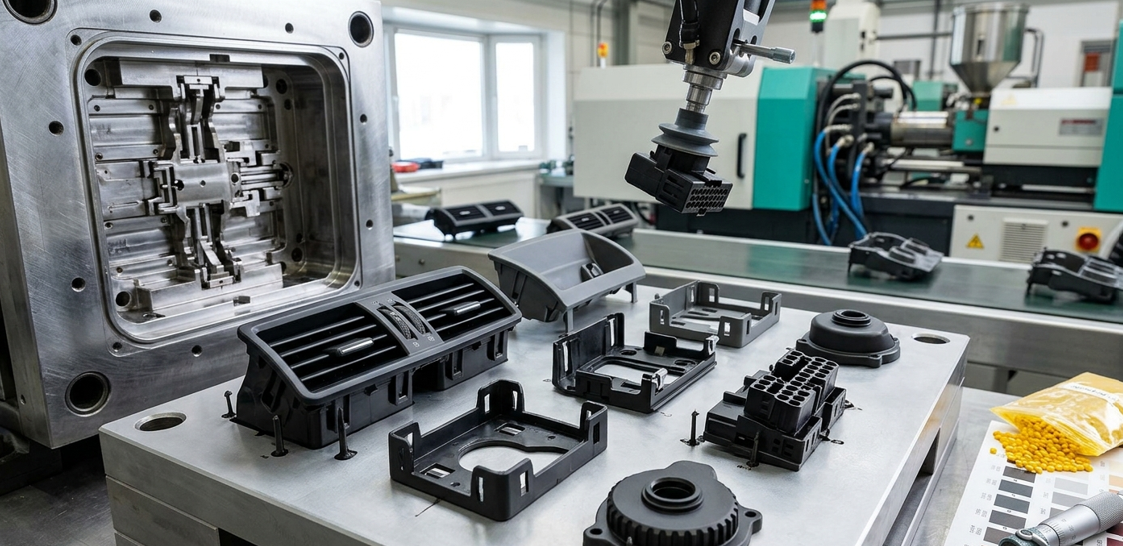
The global automotive industry is experiencing a major shift in manufacturing and sourcing strategies. Increasing supply chain disruption, cost volatility, and production uncertainty have pushed OEMs and Tier suppliers to reconsider how they structure their supplier networks.
For many manufacturers, relying too heavily on a single sourcing region creates operational risk. Delays in logistics, fluctuating production costs, and limited sourcing flexibility can directly affect manufacturing continuity and long-term business stability.
As a result, automotive companies are increasingly prioritizing supply chain diversification and scalable manufacturing partnerships. In this evolving landscape, Southeast Asia has emerged as an important manufacturing region for automotive production, particularly in plastic component manufacturing and injection molding.
Among the countries in the region, Indonesia is gaining attention as a strategic manufacturing base capable of supporting global automotive supply chains through competitive production capability, engineering support, and scalable manufacturing infrastructure.
Why Global Automotive Manufacturers Are Diversifying Supply Chains
Challenges in Traditional Single-Region Sourcing
For years, many automotive supply chains relied heavily on concentrated manufacturing regions to achieve cost efficiency and production scale. While this approach offered advantages in high-volume manufacturing, it also created structural vulnerabilities.
When disruptions occur whether from logistics issues, geopolitical uncertainty, or sudden cost increases manufacturers with highly concentrated supply chains often face production delays and reduced operational flexibility.
The Growing Importance of Supply Chain Resilience
Today, automotive OEMs are focusing not only on cost reduction but also on building resilient and diversified supply chains.
A diversified sourcing strategy helps manufacturers:
1. Reduce operational risk
2. Improve supply continuity
3. Increase sourcing flexibility
4. Balance production across multiple regions
This shift has accelerated the growth of alternative automotive manufacturing hubs outside traditional sourcing regions.
Southeast Asia’s Emerging Role in Automotive Manufacturing
Southeast Asia continues to strengthen its role within the global automotive manufacturing ecosystem. The region benefits from:
1. Expanding industrial infrastructure
2. Growing engineering capability
3. Skilled manufacturing workforce
4. Strategic export location
In addition, many countries in Southeast Asia are increasingly integrated into global OEM and Tier supplier production networks.
Rather than competing solely on low labor cost, the region is becoming recognized for its ability to support scalable, stable, and export-oriented manufacturing operations.
Automotive Injection Molding in Southeast Asia
Southeast Asia continues to strengthen its position within the global automotive manufacturing industry through expanding industrial infrastructure, growing engineering capability, and increasing integration with international OEM supply chains. For manufacturers in the United States, suppliers from Southeast Asia are becoming increasingly attractive as part of a broader supply chain diversification strategy focused on long-term stability and production flexibility.
Among the countries in the region, Indonesia is emerging as a promising manufacturing partner for automotive injection molding. Supported by a growing automotive ecosystem, export-oriented manufacturing capability, and competitive production environment, Indonesian manufacturers are increasingly capable of supporting scalable OEM production requirements for the U.S. automotive market.
Growing Demand for Automotive Plastic Components
Modern vehicles continue to incorporate more plastic components due to several industry trends:
1. Vehicle lightweighting
2. Improved fuel efficiency
3. EV platform development
4. Increased design flexibility
As a result, automotive injection molding plays a critical role in producing both functional and aesthetic vehicle components.
Applications include:
1. Interior trim components
2. Dashboard and console parts
3. Exterior covers and housings
4. Functional engineering plastic components
5. Structural support parts
The growing complexity of automotive plastic components also increases the importance of precision tooling, dimensional consistency, and process stability.
Advantages of Southeast Asia Manufacturing
Southeast Asia offers several strategic advantages for automotive injection molding production:
1. Competitive operational cost structure
2. Manufacturing scalability
3. Access to skilled technical labor
4. Strategic export connectivity
For global OEMs, these advantages support both cost efficiency and long-term production flexibility.
Indonesia as a Strategic Automotive Manufacturing Base
Indonesia has become one of the largest automotive manufacturing markets in Southeast Asia, supported by a growing ecosystem of component suppliers, tooling manufacturers, and industrial production facilities.
Its manufacturing sector continues to expand in response to increasing demand from both domestic and international automotive industries.
From a sourcing perspective, Indonesia offers:
1. Stable manufacturing capability
2. Competitive production environment
3. Engineering-oriented manufacturing support
4. Integration with regional and global supply chains
This makes Indonesia an increasingly attractive option for automotive OEMs seeking a scalable and diversified manufacturing strategy.
Automotive Injection Molding Capabilities for OEM Production
Plastic Injection Molding Automotive Parts
Injection molding is widely used for producing automotive plastic components that require:
1. Consistent dimensional accuracy
2. Repeatable production quality
3. Efficient high-volume manufacturing
Common automotive applications include:
1. Interior panels
2. Air duct systems
3. Battery and electronic housings
4. Functional covers and brackets
5. Exterior trim parts
Production consistency is especially important in automotive applications where assembly compatibility and long-term durability are critical.
Engineering Plastic Material Capability
Automotive applications often require materials with specific mechanical and thermal performance characteristics.
Common engineering plastics used in automotive injection molding include:
1. ABS
2. Polypropylene (PP)
3. Nylon (PA)
4. Polycarbonate (PC)
5. POM (Acetal)
Material selection depends on:
1. Heat resistance requirements
2. Structural performance
3. Chemical resistance
4. Dimensional stability
5. Surface finish expectations
Selecting the appropriate material is essential for balancing performance, manufacturability, and long-term durability.
Automotive Injection Mold Capability
Tooling quality is one of the most important factors in automotive injection molding performance.
Automotive injection mold capabilities typically include:
1. Single-cavity and multi-cavity molds
2. Hot runner systems
3. Precision tooling design
4. Mold optimization for cycle efficiency
Production-grade molds must be capable of maintaining stable dimensional accuracy across large production volumes while minimizing downtime and maintenance requirements.
Tight Tolerance and Production Consistency
Automotive manufacturing requires strict quality control and repeatable production performance.
Maintaining tight tolerances helps ensure:
1. Proper component fitment
2. Assembly consistency
3. Functional reliability
4. Reduced production defects
Consistent process control is critical for achieving stable output throughout long production cycles.
Integrated Manufacturing Support Beyond Injection Molding
One of the key advantages for automotive OEMs is working with suppliers that provide integrated manufacturing support rather than isolated production processes.
In-House Mold Shop Capability
An in-house mold shop allows manufacturers to better control:
1. Tooling lead time
2. Mold quality
3. Engineering coordination
4. Maintenance and tooling optimization
This integration improves communication between tooling and production teams while reducing project delays.
Jig and Checking Fixture Support
Jig and checking fixtures play an important role in automotive production by supporting:
1. Dimensional inspection
2. Production consistency
3. Assembly validation
4. Quality verification
For precision automotive applications, fixture systems help maintain repeatability across production batches.
Benefits of Integrated Manufacturing
Integrated manufacturing capability reduces supplier coordination complexity while improving production efficiency.
By combining:
3. Jig and fixture manufacturing
manufacturers can streamline project execution and improve overall production consistency.
Quality Standards Required for Automotive Injection Molding
Importance of Automotive Manufacturing Certification
Global automotive manufacturers increasingly require suppliers to operate under internationally recognized quality systems.
These standards support:
1. Process traceability
2. Consistent quality control
3. Risk management
4. Long-term production reliability
International Certifications Supporting Automotive Production
Banshu Plastic supports automotive manufacturing projects through internationally recognized certifications, including:
1. ISO 9001:2015 for quality management systems
2. IATF 16949:2016 for automotive manufacturing quality standards
3. ISO 14001:2015 for environmental management systems
These certifications demonstrate structured manufacturing processes aligned with automotive industry requirements.
Banshu Plastic as a Strategic Automotive Manufacturing Partner
With more than 20 years of experience supporting the automotive sector, Banshu Plastic has developed manufacturing capabilities focused on production consistency, tooling support, and engineering-based manufacturing solutions.
Rather than operating solely as an injection molding supplier, Banshu Plastic supports automotive manufacturing projects through:
1. Plastic injection molding production
2. In-house mold shop capability
3. Jig and checking fixture manufacturing support
This integrated approach improves coordination between tooling, production, and quality processes while supporting stable mass production performance.
In addition, Banshu Plastic has experience supporting international shipments through reliable export-import logistics partners, helping global customers maintain efficient cross-border supply chain operations.
Key Considerations When Choosing an Automotive Injection Molding Supplier
When evaluating automotive injection molding suppliers, OEMs should consider several critical factors:
Engineering and Tooling Capability
1. DFM support
2. Mold engineering expertise
3. Material selection capability
Production Scalability
1. High-volume manufacturing readiness
2. Stable process control systems
Quality and Compliance
1. Automotive certifications
2. Inspection systems
3. Traceability procedures
Communication and Global Supply Support
1. Technical responsiveness
2. Export readiness
3. Long-term collaboration capability
Selecting the right manufacturing partner is not simply about finding production capacity it is about building a reliable and scalable long-term supply relationship.
Automotive supply chains are becoming increasingly diversified as manufacturers seek greater resilience, flexibility, and operational stability.
Southeast Asia continues to emerge as a scalable manufacturing region capable of supporting global automotive production, particularly in plastic injection molding and engineered component manufacturing.
With expanding industrial capability, integrated manufacturing support, and internationally recognized quality systems, Indonesia is becoming an increasingly strategic manufacturing base for global OEM supply chains.
For automotive manufacturers seeking long-term production stability and scalable manufacturing partnerships, Southeast Asia offers a practical and increasingly competitive solution for automotive injection molding production.
Technical Consultation & RFQ Support for Automotive Injection Molding
For OEMs, Tier suppliers, and automotive product development teams, early collaboration with an experienced manufacturing partner is essential to ensure production stability, tooling efficiency, and long-term supply chain reliability.
By involving manufacturing engineers during the early development stage, critical factors such as material selection, mold design, dimensional tolerance, structural requirements, and production feasibility can be properly evaluated before mass production begins.
Banshu Plastic supports automotive injection molding projects through integrated manufacturing capabilities that include plastic injection molding, in-house mold development, and jig & checking fixture support. With injection molding machine capacity up to 850T, Banshu Plastic is able to support a wide range of automotive plastic component requirements, including larger and more complex OEM applications.
Supported by more than 20 years of automotive manufacturing experience and internationally recognized certifications including ISO 9001:2015, IATF 16949:2016, and ISO 14001:2015, Banshu Plastic provides structured manufacturing support aligned with global automotive production standards.
Engineering teams and procurement professionals can submit 3D drawings for technical feasibility evaluation, Design for Manufacturability (DFM) review, tooling consultation, and RFQ support. This process helps manufacturers evaluate the most appropriate production strategy, material selection, and tooling configuration for long-term manufacturing performance.
For technical consultation or to discuss your automotive plastic component requirements, contact our engineering team to explore scalable manufacturing solutions tailored to your OEM production and supply chain objectives.