
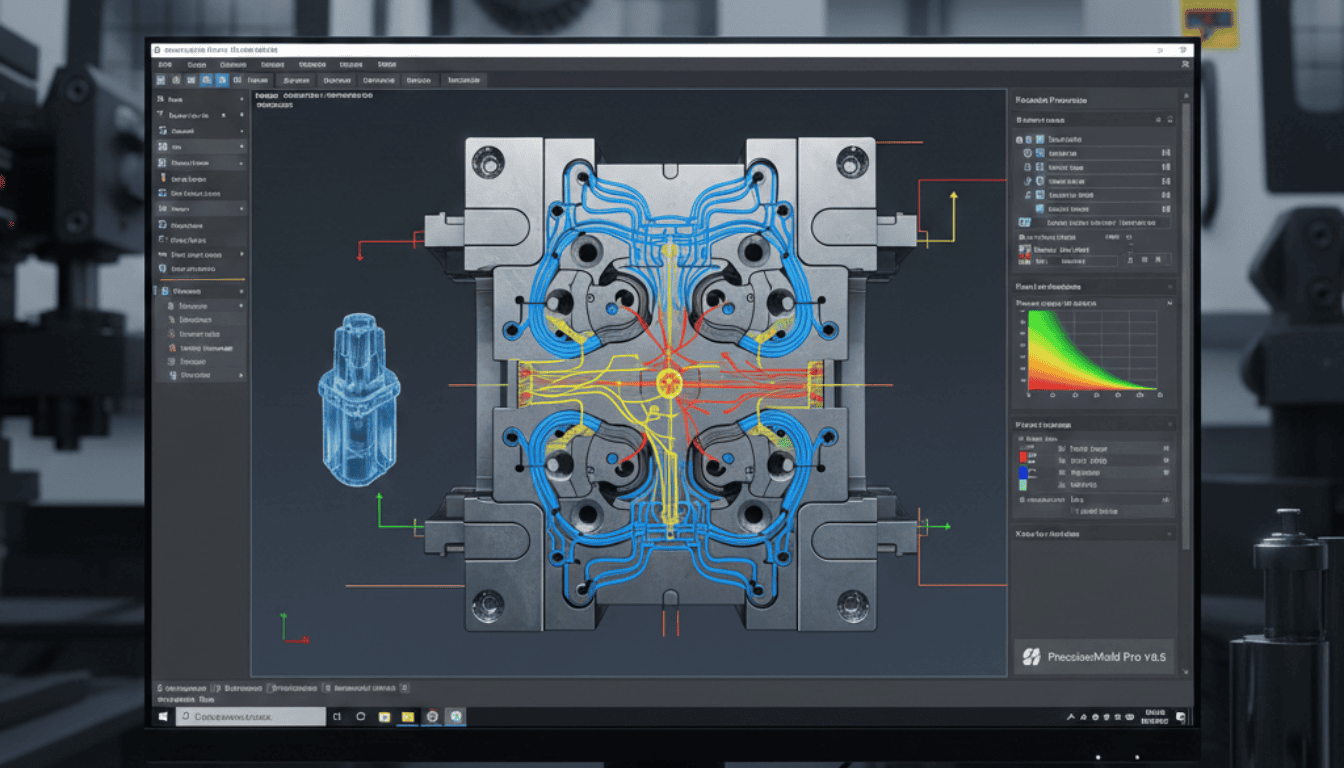
In today’s automotive industry, quality issues rarely start on the production floor, they start much earlier, at the mold design stage.
Many OEMs and Tier suppliers invest heavily in advanced injection molding machines, automation, and inspection systems, yet still face recurring problems such as dimensional instability, warpage, assembly mismatch, or inconsistent quality during mass production.
In most cases, the root cause is not the material or the machine, but insufficient precision mold design.
Precision mold & design is no longer a “nice to have” capability. It is a critical foundation for achieving stable precision injection molding, meeting automotive quality standards, and reducing long-term production risk.
Why Precision Mold Design Matters in Automotive Manufacturing
Automotive components demand far more than basic manufacturability. They must meet strict requirements related to safety, durability, consistency, and long-term performance. Even minor dimensional deviations can lead to functional failure, noise issues, or costly line stoppages at the customer’s assembly plant.
A precision mold is engineered to deliver:
- Tight dimensional tolerances
- Repeatability across millions of cycles
- Stable quality under high-volume production
- Predictable behavior across different operating conditions
Without this level of precision, quality control systems can only detect problems—not prevent them.
Common Automotive Quality Problems Caused by Poor Mold Design
Many buyers encounter the same recurring issues, even after multiple corrective actions:
- Parts pass initial trials but fail during mass production
- Dimensional drift after several thousand cycles
- Warpage or sink marks affecting assembly fit
- Flash or surface defects increasing rework and scrap
- Mold wear causing unstable quality over time
These problems are often treated as process or material issues. However, in reality, they are symptoms of a mold that was not designed with precision molding principles from the start.
Understanding Precision Mold & Design in Automotive Applications
Precision mold design goes beyond producing a mold that “can make parts.” It focuses on how the mold performs throughout the entire product lifecycle.
Key differences between standard molds and precision molds include:
- Mold design based on functional requirements, not just drawings
- Optimized gate location and flow balance
- Engineered cooling systems for thermal stability
- Proper venting to avoid burn marks and short shots
- Steel selection designed for long-term automotive programs
This approach ensures that the mold supports both product performance and production stability.
The Role of Precision Injection Molding in Meeting Automotive Standards
Automotive parts must comply with global standards such as IATF 16949, as well as OEM-specific requirements. Precision injection molding plays a central role in achieving these expectations by ensuring consistency, traceability, and predictable quality output.
Precision injection molding is the result of three elements working together:
1. Precision mold & tool design
2. Controlled and documented molding processes
3. Engineering-driven material selection
When any of these elements is missing, production risk increases significantly.
Key Elements of Precision Mold and Tool Design
To support automotive-grade production, a precision mold and tool must be engineered with the following considerations:
1. Gate and Runner Optimization
Proper gate design ensures balanced flow, minimizes internal stress, and improves surface quality.
2. Cooling System Engineering
Uneven cooling is a leading cause of warpage and dimensional instability. Precision molds use optimized cooling layouts to ensure uniform heat dissipation and stable cycle times.
3. Mold Steel and Surface Treatment
Automotive programs require molds that can withstand high-volume production without rapid wear. The right steel selection and surface treatment directly impact mold lifespan and maintenance frequency.
4. Maintenance-Friendly Design
Precision molds are designed for predictable maintenance, reducing downtime and preserving long-term quality consistency.
5. Engineering Collaboration: The Missing Link in Many Projects
One of the most common frustrations among automotive buyers is working with suppliers who simply “build what’s on the drawing,” without offering engineering feedback.
True precision mould development requires early-stage collaboration, including:
a. Design for Manufacturability (DFM) review
b. Mold flow analysis to predict potential risks
c. Material behavior analysis under real production conditions
This engineering-driven approach prevents costly changes later and ensures that the mold supports stable mass production from day one.
Precision Mold Design for High-Volume Automotive Production
Automotive injection molding is not about making a few good samples—it is about producing millions of identical parts over several years.
Precision mold design ensures:
a. Stable cycle times
b. Consistent dimensions over long production runs
c. Reduced scrap and rework
d. Lower total cost of ownership
By designing molds specifically for high-volume automotive production, manufacturers can avoid quality degradation that often appears months after SOP.
Why Automotive Buyers Need an Integrated Precision Mold Manufacturer
When mold making and injection molding are handled by separate suppliers, accountability becomes unclear. Quality issues turn into long discussions instead of quick resolutions.
An integrated precision mold and injection molding partner provides:
a. Single-point responsibility for tooling and production
b. Faster root cause analysis
c. Better alignment between mold design and process conditions
d. Reduced project risk and lead time
For automotive buyers, this integration translates directly into higher confidence and lower operational risk.
Banshu Plastic Indonesia: Precision Mold & Injection Molding Partner
Banshu Plastic Indonesia is a plastic injection molding manufacturer specializing in precision mold design and precision injection molding for automotive, electronics, and home appliance industries.
With more than 20 years of experience, Banshu Plastic offers:
- Precision mold & tool design based on automotive standards
- Engineering plastics expertise (PC, ABS, PA, PP compound, POM, ASA)
- Stable high-volume injection molding production
- Integrated tooling, molding, and quality control capabilities
Located in Jababeka Industrial Park, Cikarang, West Java, Banshu Plastic operates within Indonesia’s core automotive manufacturing ecosystem and is an active member of IMDIA (Indonesia Mold & Dies Industry Association).
The company is certified to:
- IATF 16949:2016
- ISO 9001:2015
- ISO 14001:2015
These certifications reflect Banshu Plastic’s commitment to quality, consistency, and environmental responsibility.
In automotive manufacturing, precision is not achieved by inspection alone, it is engineered from the very beginning.
When quality issues, dimensional instability, or production inconsistency continue to appear, the real solution often lies in precision mold design, not in repeated process adjustments.
By working with a manufacturing partner that truly understands precision mold & design, precision injection molding, and long-term automotive program requirements, OEMs and Tier suppliers can significantly reduce production risk, stabilize quality, and protect total cost of ownership throughout the product lifecycle.
If you are currently:
- Developing a new automotive injection molded component
- Evaluating a mold maker or injection molding supplier in Indonesia
- Experiencing recurring quality or dimensional issues in mass production
- Preparing for long-term OEM or Tier supplier programs
Banshu Plastic Indonesia is ready to support you with an engineering-driven approach, integrated precision mold and injection molding capabilities, and production stability aligned with automotive standards.
Contact Banshu Plastic to discuss your technical requirements, tooling strategy, and injection molding solutions, before quality issues become costly problems.