
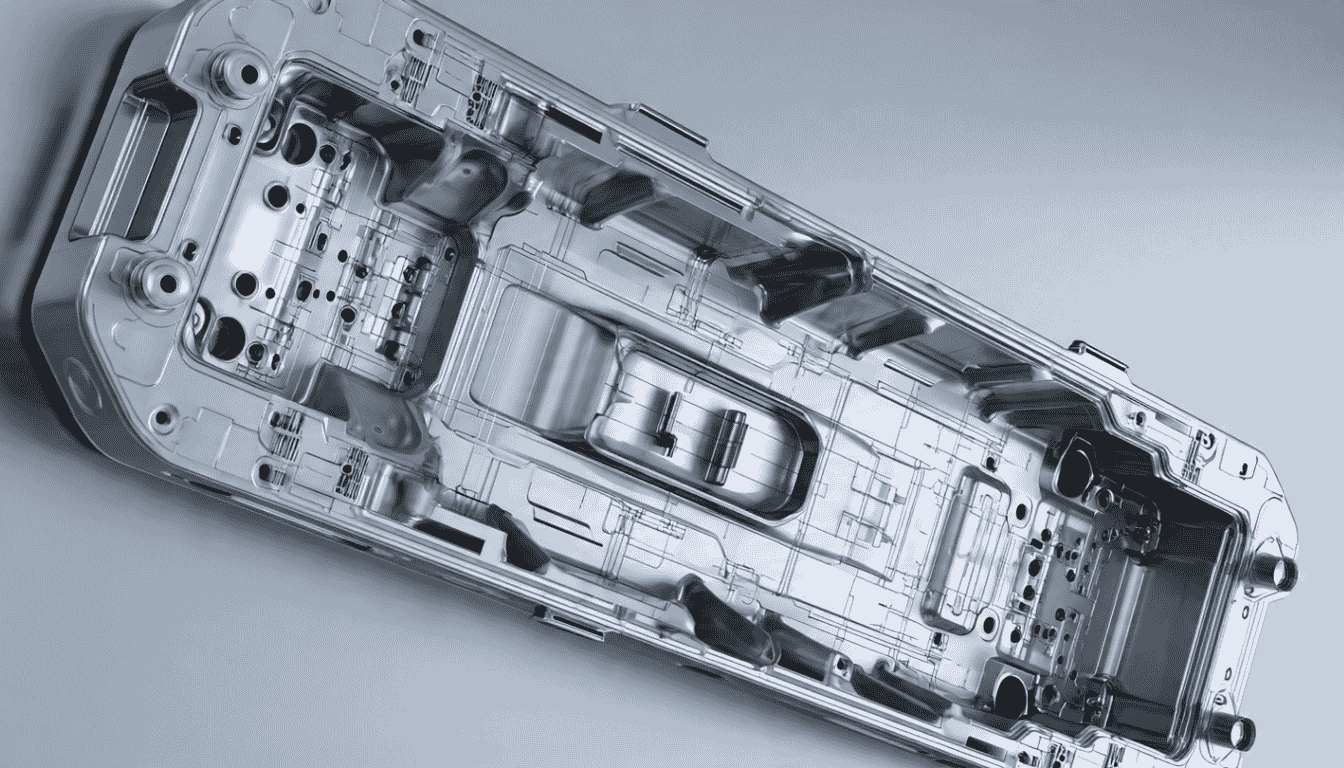
In automotive manufacturing, expectations are uncompromising. Components must meet tight dimensional tolerances, strict cosmetic standards, and consistent mechanical performance while being produced at high volumes with minimal variation.
In this environment, quality and production stability are not achieved by process adjustment alone. They are determined at the mold design stage.
Automotive injection mold design establishes the structural, thermal, and mechanical foundation of the entire molding operation.
From dimensional accuracy and defect prevention to cycle consistency and tool longevity, the mold defines whether production will remain stable over millions of cycles or become a source of recurring risk.
Dimensional Accuracy: Engineering Precision from the Start
Automotive plastic components frequently demand tight tolerances in the range of ±0.02 mm to ±0.05 mm, depending on functional interface, sealing requirements, or assembly stack-up conditions.
Such precision is common in connector housings, gear interfaces, snap-fit mechanisms, and structural alignment features.
Achieving this level of dimensional control begins at the mold design stage, not during final inspection.
1. Shrinkage Compensation and Material Behavior
Every thermoplastic resin exhibits distinct shrinkage behavior during cooling and solidification. Materials such as:
a. Polypropylene (PP)
b. ABS
c. Polyamide (PA / Nylon)
d. PC-ABS
demonstrate different volumetric contraction rates influenced by:
a. Filler percentage (mineral or glass fiber)
b. Fiber orientation
c. Wall thickness distribution
d. Mold temperature
e. Cooling rate
Glass fiber–reinforced materials introduce additional complexity due to anisotropic shrinkage. Fiber alignment along the flow direction causes directional contraction differences, directly affecting flatness and hole positioning accuracy.
For high-precision automotive components, shrinkage factors must be calculated and embedded into cavity dimensions during mold design. Failure to accurately compensate shrinkage can result in:
a. Out-of-tolerance dimensions
b. Assembly misalignment
c. Functional interference
d. Long-term dimensional drift
2. Steel-Safe Strategy in High-Precision Tooling
Many advanced injection mold programs apply a steel-safe approach, where critical dimensions are intentionally left slightly undersized during initial machining.
This strategy allows:
a. Controlled steel removal during T0/T1 sampling
b. Fine-tuning of critical features
c. Risk mitigation without weld repair
By preserving adjustment flexibility, the steel-safe method protects tolerance integrity while reducing costly rework.
3. Cavity Machining and Geometric Integrity
Even the most accurate shrinkage calculation is ineffective if cavity machining does not reflect CAD intent.
Precision CNC machining and EDM finishing determine:
a. Dimensional fidelity
b. Sharp edge definition
c. Flatness and parallelism
d. Critical feature geometry
Surface finish also influences polymer flow behavior and localized shrinkage response, particularly in high-gloss or Class-A applications.
In high-volume automotive tooling, machining accuracy must be maintained not only at initial build but throughout maintenance cycles.
4. Parting Line Alignment and Insert Precision
Parting line accuracy plays a central role in flash prevention and dimensional repeatability.
Critical components include:
a. Leader pins and bushings
b. Guide systems
c. Locking mechanisms
d. Insert seating geometry
Even minor misalignment can cause:
a. Flash formation
b. Dimensional shift
c. Inconsistent fitment between mating parts
d. Progressive wear-related variation in multi-cavity molds
Over extended automotive production runs often reaching millions of cycles small geometric deviations can amplify into substantial rejection rates and assembly disruptions.
5. Engineering Stability into the Tool
Dimensional stability in automotive injection molding cannot be achieved through inspection alone. Measurement can identify deviation, but it cannot correct fundamental geometric limitations.
True dimensional control is engineered into the mold through:
a. Accurate material shrinkage modeling
b. Precision cavity machining
c. Controlled alignment systems
d. Stable cooling configuration
e. Structured maintenance planning
In automotive programs, the mold defines the repeatability envelope. If precision is engineered from the beginning, dimensional performance remains stable throughout the lifecycle.
Dimensional stability is not inspected into the part. It is engineered into the tool.
Flow Control and Defect Prevention in Automotive Injection Molding
Material flow behavior inside the mold cavity directly determines cosmetic appearance, weld line positioning, residual stress distribution, and structural integrity.
In automotive applications, where surface quality and functional durability are critical, flow management is a primary engineering responsibility.
Defects commonly attributed to “processing instability” are often rooted in flow path design and gate strategy rather than machine capability.
Gate Type and Location Strategy
Gate design governs how molten polymer enters the cavity, fills the geometry, and packs under pressure. Gate selection must align with:
a. Part geometry
b. Wall thickness variation
c. Structural load paths
d. Cosmetic requirements
e. Material type (including fiber reinforcement)
Common gate types include:
a. Edge gate
b. Submarine (tunnel) gate
c. Pin gate
d. Valve gate
For visible automotive components, such as interior trims or exterior panels valve gating is frequently preferred because it:
a. Minimizes gate vestige
b. Reduces flow marks
c. Improves surface uniformity
d. Enhances packing control
Consequences of Improper Gate Placement
Incorrect gate positioning can result in:
a. Weld lines in structurally critical zones
b. Flow hesitation in thin-wall sections, leading to short shots or weak bonding
c. Sink marks caused by uneven packing pressure
d. Fiber orientation imbalance in glass-filled materials, reducing mechanical performance
In reinforced polymers, flow direction determines fiber alignment. Poor gate strategy can create anisotropic strength variation across the part, potentially compromising durability.
These defects are design-originated. Adjusting injection speed or pressure cannot fully compensate for flawed flow architecture.
Mold Flow Simulation as Risk Mitigation
In modern automotive tooling development, mold flow analysis is no longer optional, it is a predictive engineering requirement. Simulation enables engineers to evaluate cavity filling behavior, packing dynamics, and cooling performance before steel is cut.
By virtually modeling polymer behavior inside the mold, design risks can be identified and mitigated during the development phase rather than after tool manufacturing.
Key Simulation Outputs
Comprehensive mold flow analysis provides insight into:
1. Pressure distribution across the cavity
Identifies imbalance that may lead to short shots or overpacking.
2. Air trap and venting analysis
Detects potential burn marks, gas entrapment, or incomplete filling.
3. Weld line formation and location
Evaluates whether weld lines occur in structurally critical or cosmetic zones.
4. Warpage tendency due to differential shrinkage
Predicts deformation risk caused by uneven cooling or anisotropic material behavior.
5. Cooling channel interaction
Assesses temperature uniformity and its impact on cycle time stability.
6. Fiber orientation mapping in reinforced materials
Critical for understanding mechanical performance variation in glass fiber–filled resins.
Through early identification of flow imbalance or high-risk areas, engineers can implement corrective design measures such as:
1. Gate relocation
2. Runner system balancing
3. Wall thickness optimization
4. Cooling channel redesign
5. Venting improvement
This proactive strategy significantly reduces:
1. Trial-and-error iterations during sampling
2. Costly tooling modifications
3. SOP (Start of Production) delays
4. Scrap rates during ramp-up
Engineering Flow Before Production
In automotive injection molding, flow control cannot be achieved solely through machine parameter adjustment after defects appear. Machine settings operate within the physical constraints defined by the mold.
Proper flow behavior must be engineered into:
1. Runner and gate architecture
2. Venting strategy
3. Cooling layout
4. Material selection compatibility
When these elements are designed as an integrated system, polymer behavior becomes predictable and repeatable.
The objective is simple but critical, minimize defect probability before the first production shot is molded.
In high-volume automotive programs, stable quality does not begin on the production floor. It begins during design where material flow is modeled, simulated, validated, and optimized long before mass production starts.
Cooling System Design and Thermal Stability
Thermal management within an injection mold is a primary determinant of part quality, dimensional consistency, and production stability.
In automotive applications where tolerance stack-up and assembly precision are critical, cooling system design directly impacts downstream performance.
Temperature control is not merely about reducing cycle time; it is about maintaining thermal equilibrium throughout the mold.
Cooling Channel Layout and Thermal Balance
The distance between cooling channels and the cavity surface governs heat extraction efficiency. If this distance varies significantly across the tool, heat removal becomes uneven, resulting in localized temperature gradients.
Uneven cooling leads to:
1. Differential shrinkage
2. Warpage
3. Dimensional distortion
4. Residual stress accumulation
For complex geometries, conformal cooling, often enabled by additive manufacturing can provide improved thermal uniformity compared to conventional straight-drilled channels. By following the contour of the cavity, conformal systems maintain a more consistent thermal profile across the molded surface.
Regardless of the cooling method employed, the engineering objective remains the same: Uniform heat removal to ensure repeatable part geometry.
Warpage Control and Process Repeatability
Thermal imbalance induces internal stresses during solidification. These stresses may not always be visible immediately after ejection but can manifest later as post-mold distortion, particularly in semi-crystalline materials.
Consequences include:
1. Assembly misalignment
2. Gap variation in visible automotive panels
3. Long-term dimensional drift
A thermally balanced mold promotes:
1. Consistent shrinkage behavior
2. Reduced dimensional variation
3. Balanced packing pressure distribution
4. Repeatable cycle time
In high-volume automotive production, cycle time stability directly affects production planning, takt time adherence, and Overall Equipment Effectiveness (OEE). Thermal instability introduces variability that disrupts scheduling and reduces operational efficiency.
Thermal Balance as a Production Foundation
Cooling design must be treated as an integrated engineering discipline, coordinated with:
1. Gate positioning
2. Material selection
3. Wall thickness distribution
4. Mold base layout
Thermal balance is not an optimization step performed after trials; it is a foundational design requirement.
Stable production, dimensional reliability, and long-term part performance all begin with controlled and uniform thermal management inside the mold.
Mold Design and Production Stability Over Millions of Cycles
Production stability in automotive programs depends heavily on tool life engineering.
Tool Life and Hardness Strategy
Heat treatment and hardness specification must align with production volume expectations. Insufficient hardness accelerates wear, affecting cavity geometry and tolerance stability.
A well-engineered mold is designed not only for first approval but for sustained dimensional accuracy throughout its operational lifespan.
Moving Component Durability
Sliders, lifters, and other moving mechanisms require precise design and wear protection. Weak mechanical integration can lead to:
a. Insert misalignment
b. Increased flash
c. Premature component failure
d. Unexpected downtime
Proper lubrication paths, wear plates, and mechanical support structures extend tool life and stabilize production.
Maintenance Accessibility
Mold design should incorporate ease of preventive maintenance. Accessible inserts and modular components allow efficient servicing, reducing downtime and minimizing production interruption.
Production stability depends on durability, maintainability, and structural integrity working together.
Common Design Weaknesses That Disrupt Quality and Stability
Under high-volume automotive conditions, design flaws quickly become chronic problems.
Examples include:
1. Uneven cooling channels causing persistent warpage
2. Poor venting leading to recurring burn marks
3. Inadequate insert locking resulting in dimensional drift
4. Weak slider mechanisms causing repeated downtime
These issues are rarely solved by adjusting process parameters alone. They originate from foundational design decisions.
When mold design is optimized from the outset, quality and stability become inherent outcomes rather than corrective targets.
Engineering the Foundation of Automotive Manufacturing
Automotive injection mold design determines more than part geometry, it defines the stability of the entire production system. Dimensional precision, defect prevention, thermal balance, and mechanical durability must be engineered simultaneously.
When mold design integrates accurate shrinkage compensation, balanced flow behavior, optimized cooling, and long-term wear resistance, manufacturers achieve:
1. Consistent dimensional accuracy
2. Reduced defect rates
3. Stable cycle time
4. Extended tool life
5. Lower operational risk
In high-volume automotive manufacturing, quality and production stability are not accidental results.
They are engineered outcomes established at the mold design stage.
A robust and well-planned automotive injection mold is not merely a tool, it is the foundation of reliable and competitive production.
Engineering-Focused Manufacturing for Long-Term Automotive Production Stability
In this context, engineering discipline becomes the differentiator. For more than two decades, Banshu Plastic Indonesia has applied an engineering-focused approach to automotive plastic molding, ensuring that mold design decisions translate into measurable quality and long-term production stability.
Operating from Jababeka Industrial Park in Cikarang, strategically positioned within Indonesia’s automotive supply chain, the company supports OEMs and Tier suppliers with consistent output across high-volume programs.
Tooling quality is reinforced through active involvement in Indonesia’s mold and dies network through IMDIA membership, enabling continuous engineering improvement and alignment with global automotive manufacturing standards.
International certifications including IATF 16949:2016, ISO 9001:2015, and ISO 14001:2015 demonstrate structured quality management, disciplined process control, and environmental responsibility embedded into daily operations.
Rather than reacting to defects after production begins, engineering teams evaluate risks before molds are released, ensuring that dimensional accuracy, durability, and process stability are engineered into every program.
In automotive manufacturing, reliability is not achieved by chance, it is established at the foundation, through precise mold design, controlled processes, and long-term production discipline.