
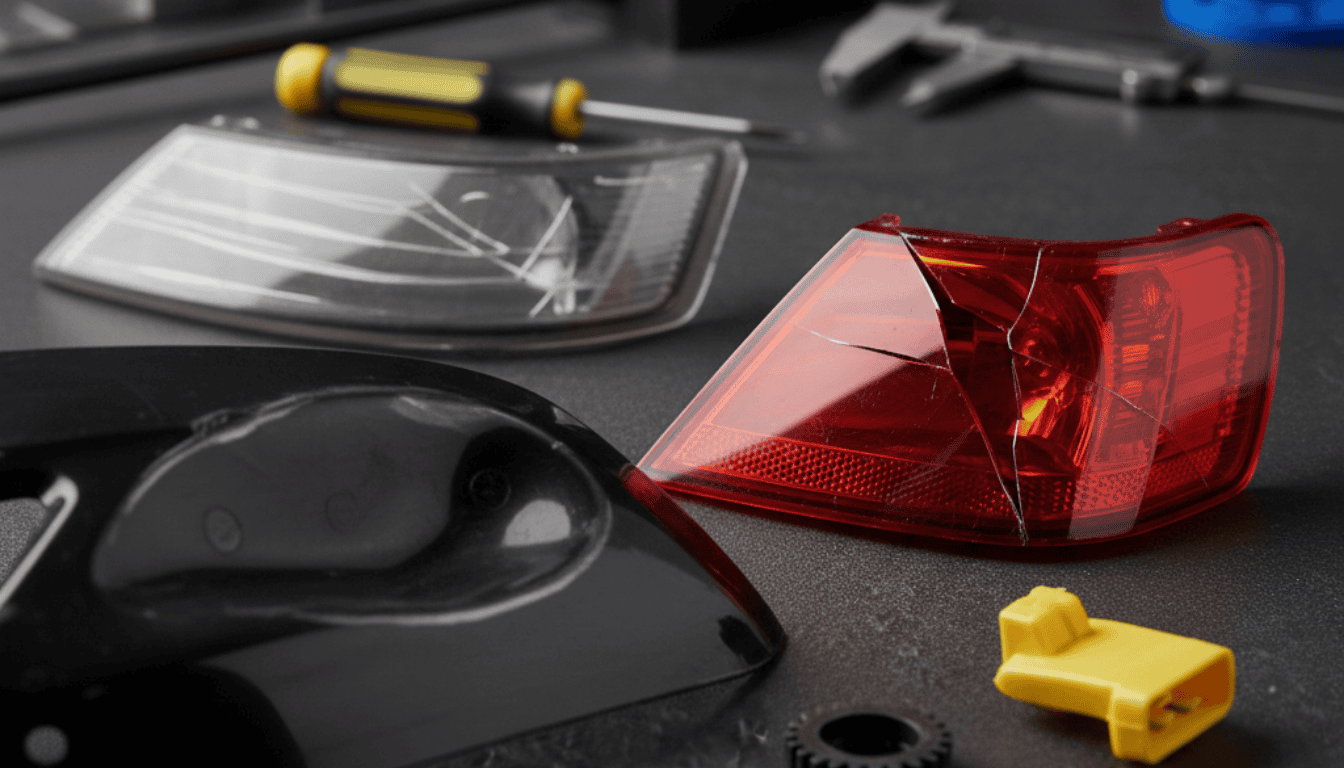
In the automotive industry, plastic component quality is not defined solely by dimensional compliance.
Visual appearance, production consistency, and long-term stability carry equal, if not greater importance, especially under strict OEM requirements.
Based on Banshu Plastic’s experience in manufacturing a wide range of automotive molded parts, one recurring pattern is clear: defects are rarely caused by a single factor.
Instead, they result from the interaction between mold design, process control, and the production environment.
This article discusses the most common defects in automotive injection molding, the part areas most sensitive to quality issues, and prevention approaches that are actually applied in real production environments, not just theoretical concepts.
Most Common Defects in Automotive Injection Molding
Based on production experience, defects most frequently occur in:
-Lens parts (lamps, indicators, transparent covers)
-Bezels (interior and exterior trim components)
These parts share similar characteristics:
- Located in highly visible areas
- High aesthetic requirements
- Extremely tight OEM tolerances
For lens parts, even minor defects such as flow marks or haze are immediately noticeable.
For bezels, defects often appear in rib areas, locking features, or surfaces that will undergo painting.
Automotive Part Areas Most Sensitive to Defects
In automotive manufacturing, not all part areas are treated equally. Certain zones are classified as high-risk quality areas, including:
1. Visual Class A Surfaces
These are surfaces directly visible to end users. Even slight flow lines, weld marks, or surface imperfections are often immediately classified as NG (No Good).
2. Painted Areas
Surfaces intended for painting are extremely sensitive to:
- Sink marks
- Flow marks
- Surface contamination
Minor defects before painting can become highly visible after the finishing process.
3. Locking & Assembly Areas
Even minimal dimensional deviations can lead to:
- Assembly difficulties
- Noise or vibration issues (NVH)
- Long-term functional failures
This is why automotive injection molding cannot be approached in the same way as general plastic products.
Common Defect Types and Their Root Causes
Flow Marks & Weld Lines (Especially in Lens Parts)
Flow marks and weld lines typically result from:
- Unstable material flow
- Uneven mold temperature distribution
- Suboptimal gate design
In lens components, weld lines are not only an aesthetic issue—they can also become structural weak points.
Sink Marks & Shrinkage (Common in Bezels)
Sink marks usually appear in:
- Rib areas
- Boss features
- Non-uniform wall thickness sections
Primary causes include:
- Imbalanced wall thickness design
- Insufficient holding pressure
- Uneven mold cooling
Warpage & Dimensional Instability
Warpage is particularly critical in:
- Locking areas
- Mating interfaces with other components
This defect is dangerous because it may not be immediately visible but often emerges during assembly or long-term use.
Critical Process Parameters Always Monitored
In automotive injection molding, four key parameters are continuously monitored:
- Temperature (material and mold)
- Pressure
- Injection speed
- Environment (especially humidity)
Based on production experience, even small variations in these parameters can significantly affect:
- Visual quality stability
- Dimensional consistency
- Batch-to-batch repeatability
Therefore, process control is not a one-time setup, it requires continuous monitoring and discipline.
Engineering Solutions Used in Real Production
In automotive molded part production, solutions do not always need to be complex, but they must be precise.
Proven approaches include:
1. Use of Jigs
Jigs ensure consistent part positioning during secondary processes and inspections, reducing dimensional variation.
2. Dehumidifiers
Critical for moisture-sensitive materials, particularly lens parts and certain engineering plastics.
These practices demonstrate that environmental control is often just as important as machine settings.
Quality Metrics Commonly Required by OEMs
There is no single universal quality metric for all automotive parts.
In practice:
- Quality metrics depend heavily on the type of part
- Requirements are defined by each OEM’s SOP and standards
Some OEMs prioritize visual quality, while others emphasize:
- Dimensional accuracy
- Mechanical strength
- Long-term durability
This is why early technical communication between OEMs and injection molding partners is essential.
Effective Defect Prevention Starts with Proper Engineering
Defects in automotive molded parts are not simple problems. Effective prevention cannot rely solely on:
-Machine parameter adjustments
-Final inspection processes
Instead, it requires a comprehensive approach that includes:
-Well-engineered mold design
-Disciplined process control
-Consistent environmental management
-Deep understanding of OEM requirements
For automotive companies, selecting an injection molding partner who understands the relationship between mold design, process control, and long-term quality risk is a strategic decision—not merely an operational one.
Ultimately, stable automotive quality is always the result of correct engineering from the very beginning.
Banshu Plastic Indonesia: An Engineering-Driven Automotive Injection Molding Partner
In automotive injection molding, defect prevention is not about end-of-line inspection, it starts with a solid engineering foundation, from mold design and material selection to stable, repeatable process control.
With more than 20 years of experience in automotive plastic injection molding, Banshu Plastic Indonesia has supported a wide range of automotive components that demand strict OEM quality standards.
Located in Jababeka Industrial Park, Cikarang, Indonesia, Banshu Plastic operates within a strategic industrial zone and supports long-term OEM and Tier supplier programs through an engineering-driven manufacturing approach.
As an active member of IMDIA (Indonesia Mold & Dies Industry Association), Banshu Plastic is closely connected to the national mold and dies ecosystem, ensuring:
- Consistent mold and tooling quality
- Continuous process improvement
- Alignment with global automotive best practices
Banshu Plastic’s quality commitment is further supported by internationally recognized certifications:
- IATF 16949:2016
- ISO 9001:2015
- ISO 14001:2015
If your company is developing automotive injection molded parts, facing recurring defect challenges, or preparing long-term production programs for OEMs and Tier suppliers, Banshu Plastic Indonesia is ready to become a manufacturing partner that understands engineering risk, quality expectations, and long-term production stability.
Contact Banshu Plastic Indonesia to discuss technical solutions for more stable, consistent, and production-ready automotive injection molding programs.