
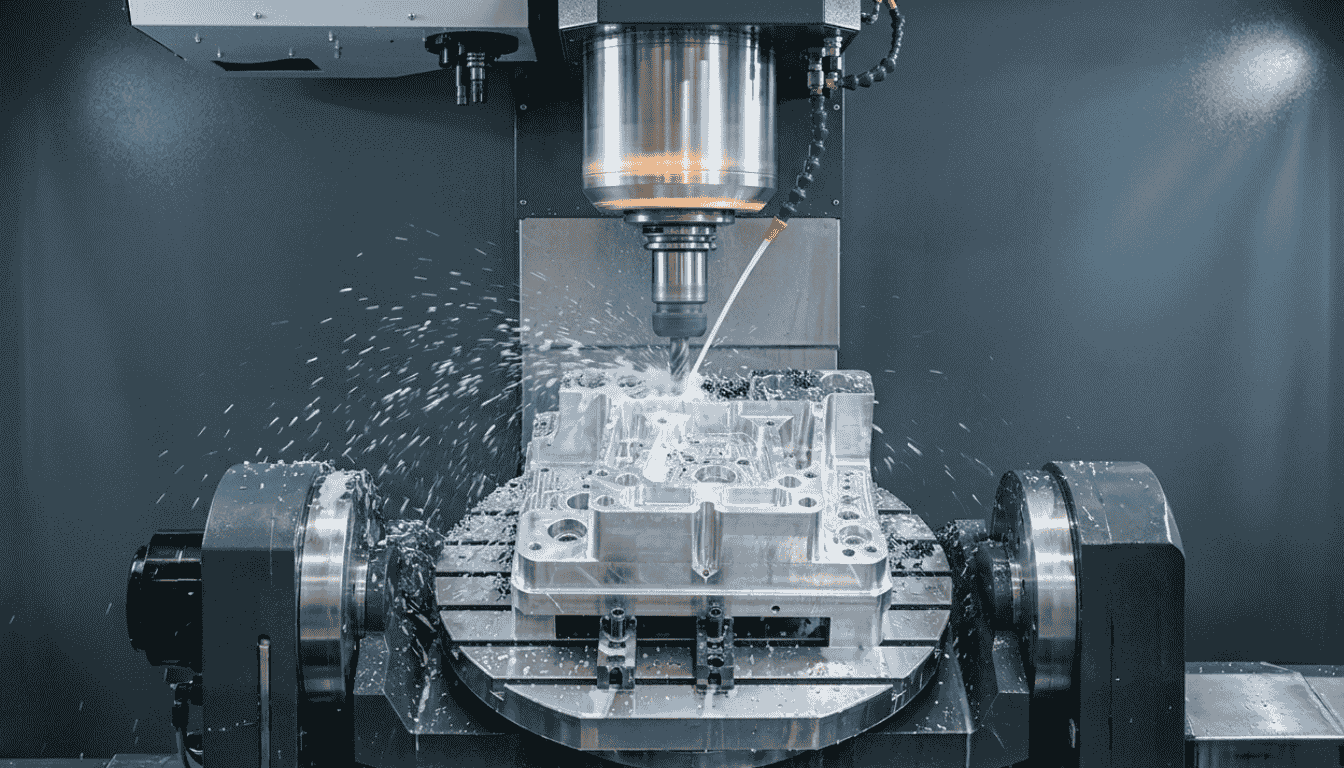
CNC (Computer Numerical Control) machining is a widely used manufacturing process for producing high-precision components with consistent quality and repeatability.
For companies developing custom plastic or engineered parts, CNC machining offers flexibility, accuracy, and fast turnaround without the need for dedicated tooling.
At Banshu Plastic, CNC machining services are designed to support a wide range of applications, from prototyping and product development to low-to-medium volume production particularly for plastic components requiring tight tolerances and reliable performance.
CNC Machining Capabilities
CNC machining enables the production of complex and highly detailed geometries with a high degree of repeatability and dimensional accuracy. At Banshu Plastic, machining capabilities are developed to accommodate a wide range of industrial requirements, from prototyping to low-volume production of precision components.
The process is particularly suitable for applications requiring tight tolerances, stable material behavior, and consistent surface quality, especially for engineering-grade plastics.
Precision and Tolerance
CNC machining is inherently capable of achieving tight dimensional control due to its computer-controlled toolpath execution and stable machining parameters. For high-precision plastic components, tolerances can typically be maintained up to ±0.01 mm, depending on factors such as material properties, part geometry, and machining strategy.
Critical considerations affecting tolerance include:
1. Thermal expansion characteristics of the material
2. Tool deflection and cutting forces
3. Geometry complexity and feature accessibility
Such precision is essential for components that require accurate interfacing within assemblies, particularly in applications involving mechanical load transfer, alignment-critical features, or dynamic motion.
Material Options
Banshu Plastic machines a broad range of engineering thermoplastics, with material selection based on functional and environmental requirements. Each material is evaluated in terms of its mechanical, thermal, and chemical performance characteristics.
Common materials include:
1. ABS (Acrylonitrile Butadiene Styrene)
Suitable for general-purpose applications requiring good machinability and balanced mechanical properties.
2. POM (Acetal/Delrin)
Offers excellent dimensional stability, low friction coefficient, and good wear resistance, making it ideal for precision mechanical components.
3. Nylon (PA)
Provides high strength and toughness with good wear resistance, commonly used for load-bearing and moving parts.
4. Polycarbonate (PC)
Known for high impact resistance and optical clarity, suitable for protective and transparent components.
5. PTFE (Teflon)
Characterized by extremely low friction and outstanding chemical resistance, typically used in sealing and sliding applications.
6. PEEK (Polyether Ether Ketone)
A high-performance thermoplastic with superior mechanical strength, thermal stability, and chemical resistance for demanding environments.
Material selection is determined based on:
a. Mechanical load and stress conditions
b. Operating temperature range
c. Exposure to chemicals or aggressive environments
D. Required dimensional stability over time
Types of Components
CNC machining is well-suited for producing a diverse range of plastic components with high precision and consistency, including:
a. Precision housings and enclosures with tight dimensional requirements
b. Mechanical components such as gears, bushings, and linear guides
c. Custom jigs and fixtures for manufacturing support
d. Functional prototypes for validation and testing
e. Low-volume production parts requiring repeatable quality
These components are typically utilized in applications where dimensional accuracy, material performance, and long-term reliability are critical to overall system functionality.
CNC Machining Processes
CNC machining is a structured, multi-stage process designed to ensure that each component meets defined engineering specifications, dimensional tolerances, and quality standards. The workflow integrates design validation, process planning, controlled machining execution, and rigorous inspection.
Design and Engineering
The process begins with a 2D technical drawing or 3D CAD model that fully defines part geometry, dimensional tolerances, and critical features. At this stage, Design for Manufacturability (DFM) principles are applied to optimize the component for efficient and stable machining.
Key engineering considerations include:
a. Feature geometry and accessibility for cutting tools
b. Tolerance stack-up and critical dimensions
c. Material-specific behavior such as shrinkage, thermal expansion, and internal stress
d. Wall thickness uniformity to minimize deformation
Early-stage evaluation ensures that the design is compatible with CNC machining constraints while maintaining functional requirements.
CNC Programming
The validated design is translated into machine-readable instructions using CAM (Computer-Aided Manufacturing) software. This stage defines the complete machining strategy, including:
a. Toolpath generation (roughing, semi-finishing, finishing)
b. Cutting sequence and operation planning
c. Tool selection and tool engagement strategy
d. Machining parameters such as spindle speed, feed rate, and depth of cut
Effective CNC programming is critical to achieving optimal surface integrity, dimensional accuracy, and cycle time efficiency.
Improper toolpath strategies or parameter selection can lead to issues such as tool deflection, poor surface finish, or thermal distortion particularly when machining thermoplastics.
Machine Operation
The programmed toolpaths are executed on CNC equipment under controlled conditions. Depending on part geometry and feature requirements, operations may include:
a. CNC milling for complex geometries, pockets, and freeform surfaces
b. CNC turning for rotational or cylindrical components
c. Secondary operations such as drilling, reaming, and tapping for holes and threaded features
Machining of plastic materials requires tighter control compared to metals due to their lower melting temperatures and higher thermal expansion coefficients. Critical process controls include:
a. Optimizing cutting speed and feed rate to reduce heat buildup
b. Using sharp tooling to prevent material smearing or burr formation
c. Managing chip evacuation to avoid re-cutting and surface damage
Process stability at this stage directly impacts part accuracy, surface finish, and repeatability.
Quality Control and Inspection
Quality assurance is integrated throughout the machining process to ensure compliance with specified requirements. Inspection is conducted at both in-process and final stages, depending on part criticality.
Typical inspection methods include:
a. Dimensional verification using precision measuring instruments (e.g., calipers, micrometers, CMM)
b. Surface quality assessment to detect defects such as tool marks, burrs, or deformation
c. Functional and fit testing for assembly-critical components
For high-precision applications, inspection data may be documented to ensure traceability and consistency across production batches.
Consistent implementation of quality control procedures ensures that each component meets customer specifications and can be reliably integrated into downstream assemblies without additional rework.
Applications of CNC Machining
CNC machining is widely applied across industries that require high dimensional accuracy, material consistency, and flexibility in component design.
The process is particularly advantageous for engineering thermoplastics, where precise control over geometry and surface integrity is critical to functional performance.
Automotive Components
In the automotive sector, CNC machining is utilized for producing precision plastic components used in both interior and under-the-hood applications. Typical parts include housings, mounting brackets, and electrical insulation components.
These components are often required to:
a. Maintain tight dimensional tolerances for assembly integration
b. Withstand thermal cycling and mechanical vibration
c. Provide electrical insulation and chemical resistance
Material selection and machining strategy must account for environmental exposure and
long-term dimensional stability.
Electronics and Electrical
CNC machining is commonly used to manufacture non-conductive and high-precision components for electronic and electrical systems. These include enclosures, connectors, insulation parts, and component carriers.
Key technical requirements in this sector include:
a. Electrical insulation performance
b. High dimensional accuracy for component alignment
c. Consistent surface finish to ensure proper sealing or contact interfaces
Engineering plastics such as POM, PC, and PTFE are frequently selected for their dielectric properties and stability.
Industrial Equipment
In industrial machinery, CNC-machined plastic components are widely used to replace metal parts in applications where reduced friction, weight, or corrosion resistance is required.
Common applications include:
a. Wear-resistant components operating under continuous motion
b. Linear guides and bushings requiring low friction and dimensional stability
c. Custom jigs, fixtures, and tooling aids for manufacturing processes
These components must sustain mechanical loads while minimizing wear, deformation, and maintenance requirements over time.
Prototyping and Product Development
CNC machining is a preferred method for functional prototyping due to its ability to produce parts directly from CAD data without the need for dedicated tooling. This enables rapid iteration and validation of design concepts under real operating conditions.
Compared to molding processes, CNC machining allows:
a. Immediate design modifications without tooling changes
b. Evaluation of material performance in end-use conditions
c. Reduced lead time for design verification and testing
This makes it highly effective in early-stage product development and engineering validation workflows.
Benefits of CNC Machining Services
CNC machining provides several technical and operational advantages, particularly for low- to medium-volume production and high-mix component requirements:
a. High dimensional accuracy and repeatability across production batches
b. Broad material compatibility with engineering-grade thermoplastics
c. Elimination of tooling investment, reducing upfront cost and risk
d. Short lead times for prototypes and small-batch production
e. Capability to machine complex geometries and tight-tolerance features
These characteristics make CNC machining a flexible and efficient solution for both development and specialized production scenarios.
CNC machining is a versatile and reliable manufacturing process for producing high-precision plastic components with consistent quality.
Through the integration of optimized machining strategies, appropriate material selection, and rigorous quality control, it is possible to achieve stable and repeatable performance across a wide range of industrial applications.
At Banshu Plastic, CNC machining services are developed to support engineering teams with accurate, flexible, and application-driven manufacturing solutions.
The focus is placed on ensuring that each component meets functional requirements, dimensional specifications, and performance expectations within its intended operating environment.
Technical Consultation & RFQ Support for CNC Machining Projects
For companies developing custom plastic components, early collaboration with a CNC machining partner can significantly improve design feasibility, material selection, and production efficiency.
By engaging in technical discussions during the early stage, factors such as tolerance requirements, material behavior, and machining strategy can be evaluated to ensure optimal manufacturing outcomes.
Banshu Plastic supports CNC machining projects through a structured engineering approach, including manufacturability analysis, material guidance, and precision machining capabilities.
This helps ensure that each component meets performance requirements while maintaining consistent quality.
Engineering teams and procurement professionals can submit 2D or 3D drawings for technical review or request RFQ support to evaluate suitable materials, machining approaches, and production scalability.
For technical consultation or to discuss your project requirements, contact our engineering team to explore CNC machining solutions aligned with your application needs.