
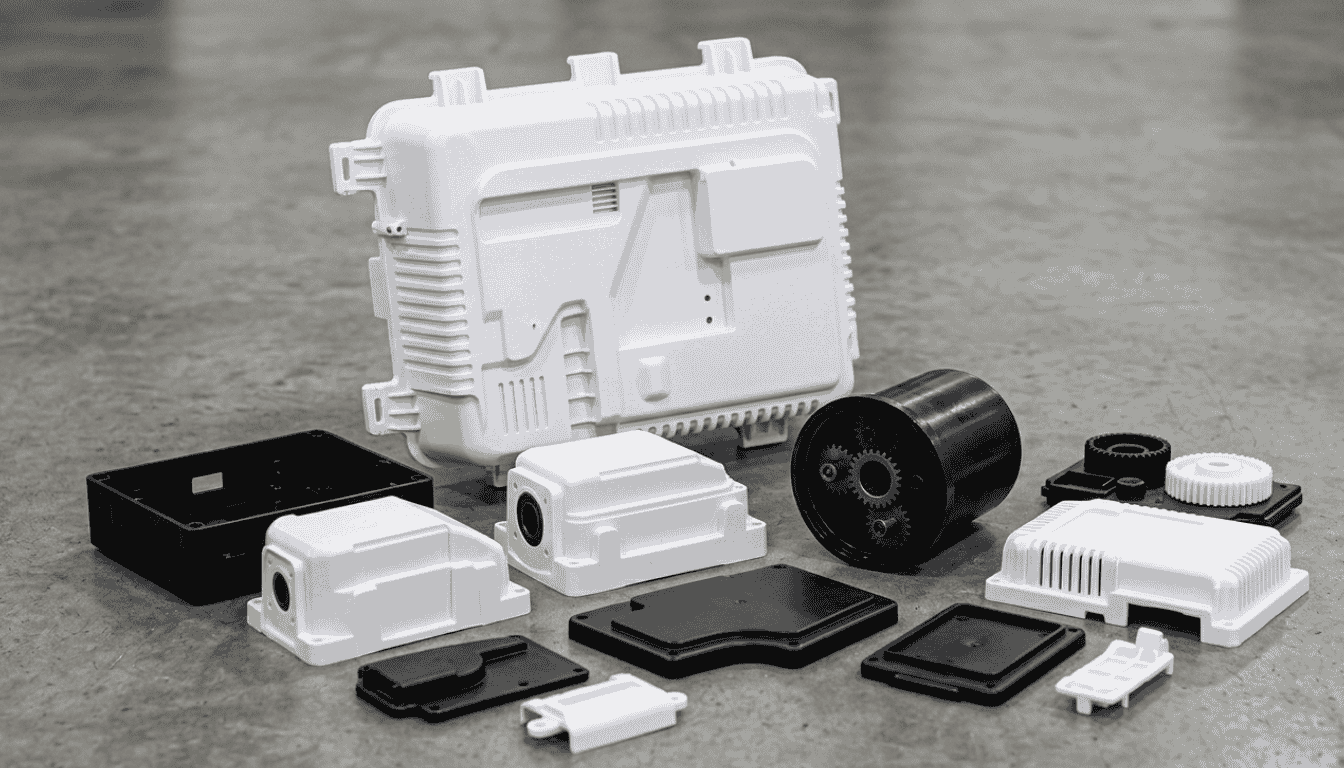
Plastic injection molding is one of the most widely used manufacturing processes for producing high-precision thermoplastic components at scale. Among the many materials available, ABS plastic injection molding remains one of the most widely adopted solutions due to its balanced mechanical properties, dimensional stability, and high-quality surface finish.
Manufacturers frequently select ABS when producing components that require both functional performance and aesthetic consistency. The material offers good impact resistance, stable processing behavior, and excellent paintability, making it suitable for applications ranging from automotive interior parts to consumer electronics housings.
In both standard and custom plastic injection molding projects, ABS enables reliable production of complex geometries with tight dimensional tolerances. For this reason, ABS is commonly processed in high-volume manufacturing environments within a modern plastic injection molding factory, where controlled processing parameters and engineered tooling ensure consistent part quality across large production runs.
This article explains the key properties of ABS plastic, how the injection molding process works, and why ABS continues to be widely used across multiple industrial applications.
What Is ABS Plastic?
Acrylonitrile Butadiene Styrene (ABS) is a widely used thermoplastic polymer composed of three distinct monomers: acrylonitrile, butadiene, and styrene. The combination of these materials creates a polymer with balanced mechanical strength, durability, and processability, making it highly suitable for injection molding applications.
Each monomer contributes specific performance characteristics:
1. Acrylonitrile provides chemical resistance and thermal stability.
2. Butadiene improves toughness and impact resistance.
3. Styrene contributes rigidity and enables a smooth, high-quality surface finish.
Because of this carefully engineered composition, ABS delivers a versatile set of mechanical and processing properties that support efficient large-scale manufacturing.
Key Properties of ABS
ABS is valued in manufacturing because it offers a reliable balance between strength, appearance, and manufacturability. Some of its most important characteristics include:
1. High impact resistance, allowing parts to withstand mechanical stress and sudden loads
2. Good dimensional stability, ensuring consistent part accuracy during production
3. Smooth surface finish, suitable for visible components and aesthetic applications
4. Excellent paint adhesion, enabling high-quality painted or coated finishes
5. Good machinability and post-processing capability, allowing drilling, trimming, or secondary operations when required
These properties make ABS a dependable material for producing plastic components that require both durability and visual quality in high-volume production environments.
The ABS Plastic Injection Molding Process
In industrial manufacturing environments, ABS plastic injection molding is widely used to produce high-precision plastic components with consistent quality. The process involves melting ABS pellets and injecting the molten material into a precision mold cavity to form the final part.
Because of its repeatability and efficiency, this process is commonly used for high-volume production in a plastic injection molding factory, especially for components that require tight dimensional tolerance and reliable mechanical performance.
1. Material Preparation
The process begins with preparing the ABS raw material. ABS pellets must be properly dried before processing because excessive moisture can cause defects such as bubbles, silver streaks, or poor surface finish.
For manufacturers and product developers, proper material preparation is essential to ensure stable melt flow, consistent mechanical properties, and reliable production quality.
2. Plastic Melting
After drying, the ABS pellets are fed into the injection molding machine. Inside the heated barrel, a rotating screw gradually moves the material forward while melting it into a uniform molten state.
Typical processing temperatures for ABS range between 200°C and 250°C, depending on the material grade and product requirements.
Careful temperature control ensures optimal flow behavior and helps maintain the structural integrity of the molded components.
3. Injection into the Mold
Once the material reaches the correct viscosity, the molten ABS is injected into the mold cavity under high pressure.
The mold design plays a critical role in determining the final part geometry, surface texture, wall thickness distribution, and structural features.
For companies developing new products, well-engineered molds are essential to achieve consistent dimensional accuracy and repeatable production results.
4. Cooling and Solidification
After the mold cavity is filled, the molten ABS begins to cool and solidify. Cooling channels integrated within the mold help regulate temperature and ensure uniform solidification across the part.
Proper cooling design is important to minimize warpage, shrinkage variation, and internal stress, which can affect both product performance and assembly compatibility.
5. Part Ejection
Once the material has fully solidified, the mold opens and ejector pins push the finished component out of the cavity.
In a modern plastic injection molding factory, this cycle runs automatically and continuously, enabling manufacturers to produce large volumes of identical parts with high precision, stable quality, and efficient production throughput.
Advantages of ABS in Injection Molding
ABS offers several advantages that make it one of the most widely used materials in custom plastic injection molding. Its balanced mechanical properties, processability, and cost efficiency make it suitable for both functional and cosmetic plastic components across many industries.
1. Excellent Impact Resistance
One of the key advantages of ABS is its high impact resistance. The material can absorb mechanical stress without cracking or breaking easily.
Because of this property, ABS is frequently used for components that experience repeated handling, vibration, or mechanical load during operation.
2. High-Quality Surface Finish
ABS naturally produces smooth and consistent surface finishes during the molding process. This characteristic makes it highly suitable for visible or exterior components.
In addition, ABS parts can be easily painted, plated, laser-marked, or textured, allowing manufacturers to achieve both functional and aesthetic design requirements.
3. Good Dimensional Stability
ABS provides reliable dimensional stability during injection molding. The material maintains consistent shape and size during cooling, which helps ensure accurate assembly with other components.
For manufacturers producing precision parts, this stability helps reduce tolerance variation, fitting issues, and secondary adjustments during production.
4. Cost Efficiency for Mass Production
Compared with many engineering plastics, ABS offers an excellent balance between mechanical performance and material cost.
Its stable processing behavior and high production efficiency make it a preferred material for high-volume manufacturing in a plastic injection molding factory, especially for industries that require consistent quality at competitive production costs.
Common Applications of ABS Injection Molded Parts
ABS is widely used across multiple industries due to its versatility, durability, and ability to produce high-quality molded components.
1. Automotive Components
In the automotive industry, ABS is commonly used for interior and functional components such as dashboard panels, interior trims, ventilation housings, and control panel parts.
These components benefit from ABS’s impact resistance, dimensional stability, and ability to produce smooth surface finishes suitable for visible interior parts.
2. Motorcycle Plastic Parts
ABS is also widely used for motorcycle plastic components, including fairings, side covers, instrument housings, and exterior body panels.
Its combination of durability and excellent paint adhesion makes it suitable for both structural and aesthetic motorcycle parts.
3. Consumer Electronics
Electronics manufacturers frequently use ABS to produce housings and protective enclosures for products such as laptops, televisions, and home appliances.
The material provides a strong yet lightweight structure while maintaining a clean and consistent exterior finish.
4. Industrial Equipment
In industrial environments, ABS is commonly used for equipment housings, protective covers, and control box enclosures.
These components require reliable mechanical strength and consistent performance during long-term operation.
Design Considerations for ABS Injection Molded Parts
When designing components for custom plastic injection molding, engineers must consider the material’s processing characteristics.
1. Wall Thickness
Uniform wall thickness helps ensure proper material flow during molding. Uneven walls can lead to defects such as sink marks or warpage.
2. Draft Angles
Draft angles are necessary to allow molded parts to be easily removed from the mold without damaging the surface.
3. Rib and Boss Structures
Reinforcement ribs and bosses are often added to increase structural strength without significantly increasing material usage.
4. Shrinkage Control
Like all thermoplastics, ABS shrinks slightly during cooling. Mold designers must account for this shrinkage to maintain dimensional accuracy.
ABS Compared with Other Injection Molding Materials
Although ABS is widely used in plastic injection molding, engineers often compare it with other thermoplastics depending on specific application requirements.
For example, Polypropylene (PP) offers excellent chemical resistance, low density, and cost efficiency, making it suitable for functional components where appearance is less critical. However, PP typically provides lower surface quality and rigidity compared to ABS.
Polycarbonate (PC), on the other hand, delivers superior heat resistance and exceptional impact strength.
This makes it ideal for applications requiring high durability or transparency, such as protective covers and optical components. The trade-off is that PC generally has higher material costs and can be more challenging to process.
Despite these alternatives, ABS frequently remains the preferred material when manufacturers require a balanced combination of toughness, dimensional stability, smooth surface finish, and cost-effective production.
For many custom plastic injection molding projects, ABS provides the optimal compromise between performance and manufacturability.
Why ABS Is Popular for Custom Plastic Injection Molding
Many manufacturers choose ABS for custom plastic injection molding because it supports complex part geometries while maintaining consistent quality. The material flows well during molding, allowing engineers to produce components with detailed features and precise dimensions.
ABS is also highly reliable in high-volume production environments. In a modern plastic injection molding factory, the material can be processed efficiently to produce large quantities of parts with excellent repeatability and minimal variation.
Because of this balance of processability, durability, and surface quality, ABS remains one of the most practical materials for manufacturing high-quality plastic components across a wide range of industries.
Looking for a Reliable ABS Plastic Injection Molding Partner?
If you are developing products that require durable, high-quality plastic components, choosing the right manufacturing partner is essential.
At Banshu Plastic, we specialize in custom plastic injection molding, delivering precision parts with consistent quality and efficient production.
With advanced manufacturing capabilities and extensive experience in ABS plastic injection molding, our team supports your project from design evaluation to mass production.
Visit banshuplastic.com to learn more or discuss your project with our team.